

Table of Contents
- Atelier Grade vs Mass Produced Evening Wear: A Detailed Comparison
- Defining Atelier Grade and Mass Produced Evening Wear
- Why Fabric Quality Matters for Cocktail Dresses
- Signs of High-Quality Garment Construction
- The Fitting Process and Customisation
- Cost-Per-Wear Analysis: Value Beyond the Price Tag
- Atelier Grade vs Mass Produced: Which Is Right for You?
Last Updated: August 17, 2026
Atelier Grade vs Mass Produced Evening Wear: A Detailed Comparison
When you're shopping for evening wear, the price difference between an atelier grade gown and a mass-produced dress can be staggering. But understanding what you're actually paying for, and whether it's worth it, requires knowing exactly how these garments differ in construction, fabric, and longevity. This guide breaks down atelier grade vs mass produced evening wear so you can make an informed decision based on your needs, budget, and how often you'll wear the piece.
At MISTY'S, we curate evening gowns that balance quality craftsmanship with accessible pricing. Whether you're drawn to atelier-inspired pieces or prefer contemporary ready-to-wear options, knowing the real differences helps you choose a dress that will look and feel exceptional on the night that matters.
Defining Atelier Grade and Mass Produced Evening Wear
Atelier grade evening wear is a garment constructed in a small workshop or boutique setting, typically with significant hand-finishing, limited production runs, and extensive customisation options. The term "atelier" comes from French couture tradition, where master tailors oversee every detail of construction.
Mass-produced evening wear is manufactured in large factories using standardised patterns, industrial machinery, and assembly-line processes. These garments are designed for volume production, with minimal hand-finishing and limited customisation.
The distinction matters because it shapes everything from how the dress fits your body to how long it will last. Atelier grade pieces prioritise individual fit and craftsmanship; mass-produced garments prioritise consistency and cost efficiency.
Here's where the confusion often starts: many retailers use "atelier-inspired" or "couture-style" marketing language to describe mass-produced dresses. This doesn't make them atelier grade. True atelier construction involves hand-stitching, made-to-order production, and bespoke fitting, processes that simply don't scale to factory volumes.
The Fashion Institute of Technology's guide to garment construction standards outlines the technical distinctions between handmade and industrial production methods. Understanding these differences is essential before you spend significant money on evening wear.
Why Fabric Quality Matters for Cocktail Dresses
The fabric is where atelier grade and mass-produced evening wear diverge most visibly. This isn't just about how the dress looks in photos, it's about how it moves, drapes, and ages.
Atelier-grade gowns typically use natural fibres: silk charmeuse, silk chiffon, linen blends, or high-quality wool. These materials have inherent structure and movement. They respond to the wearer's body, creating elegant drape and silhouette. Natural fabrics also develop a subtle patina over time, often improving with wear and proper care.
Mass-produced evening dresses frequently use polyester blends or synthetic microfibre. Polyester is cheaper to source, easier to dye in bulk, and requires less specialised handling during manufacturing. However, polyester doesn't drape like silk. It clings rather than flows, and it can look plasticky under certain lighting.
The hand-feel differs dramatically. Run your fingers across a silk charmeuse gown and you'll notice the slight resistance and smoothness. Polyester feels slippery and uniform, there's no variation in texture.
Here's what most people don't realise: cheaper synthetic fabrics degrade faster. Polyester loses its sheen after a few wears, pilling becomes visible, and the fabric begins to look tired. Natural fibres age more gracefully. A silk gown worn five times looks better than a polyester dress worn twice.
For cocktail dresses specifically, fabric choice affects how the dress photographs. Silk catches light in a way that photographs beautifully; polyester can create harsh reflections or look flat in photos. If you're attending an event where professional photography is involved, the fabric choice will be visible in every image.
Textile Exchange's sustainability report on natural versus synthetic fibres provides data on the durability and environmental impact of different fabric types, useful context if longevity matters to your purchase decision.
Signs of High-Quality Garment Construction
Construction quality separates a dress that will last five years from one that falls apart after two wears. Here are the specific markers of atelier-grade craftsmanship.

Hand-stitching and seam finishing: Atelier garments feature hand-stitched seams, particularly in visible areas like necklines and armholes. Hand-stitching is stronger than machine-stitching because each stitch is individually secured. Look inside the dress: if you see a continuous line of perfectly uniform stitches, that's machine work. If you see slight variations in stitch length and spacing, that's hand-stitching. Mass-produced dresses use machine-stitching throughout, which is faster but less durable under stress.
Seam allowances and interior finishing: Atelier garments have generous seam allowances, leaving room for alterations and providing structural integrity. The interior is finished with French seams or bound edges, meaning the raw fabric edges are enclosed or neatly finished rather than left exposed. This prevents fraying and looks polished when you move. Mass-produced dresses often have minimal seam allowances and raw, unfinished edges inside.
Lining and interlining: Quality evening wear includes a full lining in natural fibres (cotton, silk, or linen), which prevents the outer fabric from clinging to your body and provides structure. Interlining, a stabilising layer between the outer fabric and lining, is used in atelier pieces to add body and maintain shape. Mass-produced dresses may have partial linings or synthetic linings that don't breathe, making the dress uncomfortable to wear.
Embellishment attachment: Hand-sewn beads, sequins, and embroidery are secured individually in atelier garments, meaning each embellishment is knotted off separately. This takes time but ensures that if one bead comes loose, the others remain secure. Mass-produced embellishments are often glued or attached with a single thread running through multiple pieces, so if the thread breaks, you lose an entire section of beading.
Button and closure quality: Atelier garments use quality buttons (bone, mother-of-pearl, or metal) attached with reinforced thread and a thread shank (a small gap between button and fabric that allows the buttonhole to close without stress). Mass-produced dresses often use plastic buttons glued or poorly stitched directly to the fabric.
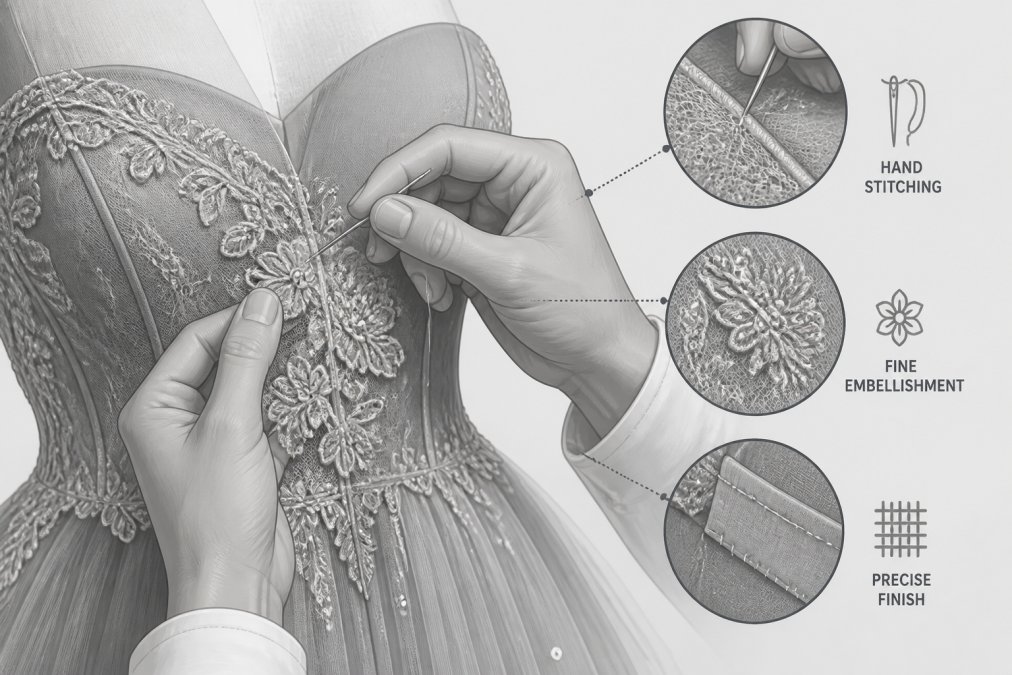
The easiest way to spot construction quality is to examine the interior. Turn the dress inside out and look at the seams, hems, and closures. If everything is neatly finished and the stitching is consistent and secure, you're looking at quality construction. If the interior is rough, with loose threads and visible glue, the dress won't hold up.
The Fitting Process and Customisation
This is where atelier grade and mass produced evening wear create fundamentally different experiences.
Atelier-grade garments are typically made-to-order or bespoke, meaning the dress is constructed specifically for you. The fitting process involves multiple appointments: an initial consultation where your measurements are taken and the design is discussed, a first fitting where the dress is basted together and adjustments are made, and a final fitting before completion.
During fittings, a skilled tailor evaluates how the dress sits on your body. They adjust the waist, neckline, armhole depth, and sleeve length based on your posture, proportions, and preferences. The goal is a dress that fits without alterations, or requires only minor tweaks.
Mass-produced evening wear follows a standardised sizing chart. You select a size based on your bust, waist, and hip measurements, and the dress arrives ready-to-wear. If it doesn't fit perfectly, you either accept the fit or pay for alterations.
Here's the practical difference: an atelier dress is engineered for your body. A mass-produced dress is engineered for an average body within a size range. If you're between sizes, have an unusual proportion (broad shoulders with narrow hips, for example), or prefer a specific fit, atelier construction delivers what you need. Mass-produced sizing will always be a compromise.
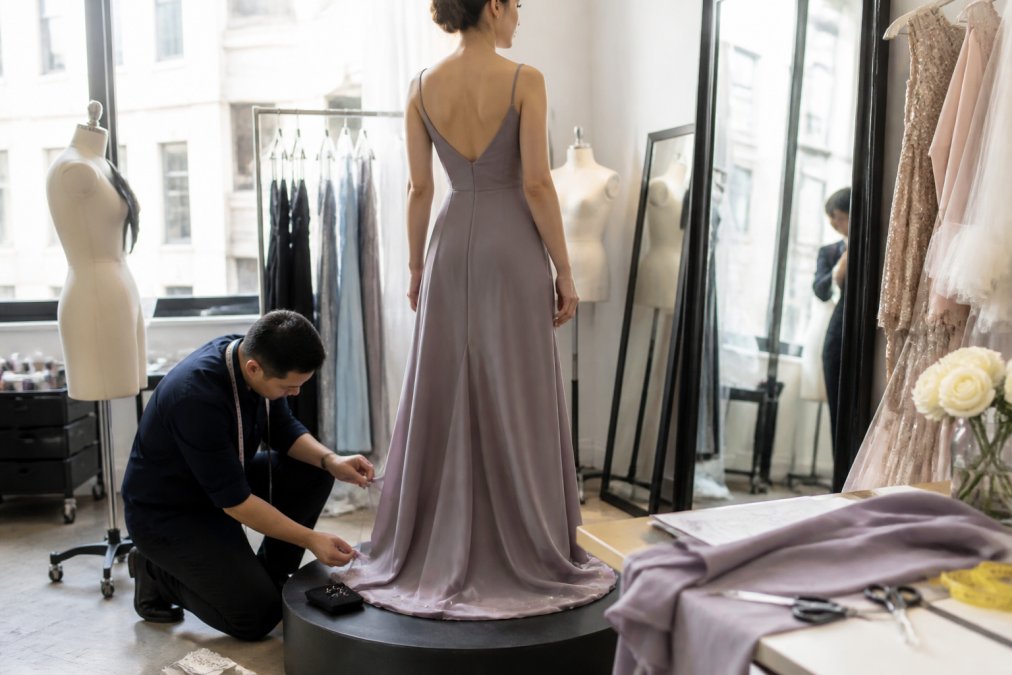
The customisation aspect extends beyond fit. With atelier garments, you can request modifications: a different neckline, adjusted sleeve length, additional pockets, or changes to embellishment placement. Mass-produced dresses come as-is. You can alter them after purchase, but you can't change the design.
For formal events where the dress needs to be perfect, the atelier approach eliminates guesswork. You know the dress will fit because it was made for you. With mass-produced options, you're hoping the sizing chart is accurate and that alterations will resolve any fit issues.
Cost-Per-Wear Analysis: Value Beyond the Price Tag
The sticker price difference is obvious: an atelier gown might cost three to four times more than a mass-produced dress. But cost-per-wear tells a different story.
Let's say you purchase a mass-produced evening dress for $150. You wear it twice, then it develops pilling, the lining tears, and a seam starts to come loose. You've worn it twice, so your cost-per-wear is $75 per occasion.
Now consider an atelier gown at $500. You wear it to five events over three years. You have it professionally cleaned between wears. The fabric maintains its appearance, the construction holds firm, and it still looks elegant at the fifth wearing. Your cost-per-wear is $100 per occasion, higher per wear, but the dress delivered five wearable occasions instead of two.
The calculation shifts further if you wear the dress more frequently. An atelier piece worn ten times costs $50 per wear. A mass-produced dress worn ten times would likely have deteriorated significantly by the tenth wearing, whereas the atelier piece is still in excellent condition.
Several factors influence cost-per-wear:
| Factor | Atelier Grade | Mass Produced |
|---|---|---|
| Durability | 5-10+ wears | 2-4 wears |
| Maintenance cost | Moderate (professional cleaning) | Low to moderate |
| Alteration needs | Minimal | Often required |
| Resale value | 40-60% of original | 10-20% of original |
| Estimated cost-per-wear | $40-100 | $50-150 |
The resale value factor is significant. Atelier-grade garments retain value because they're well-constructed and often timeless in design. You can sell an atelier gown on the secondhand market for a reasonable percentage of what you paid. Mass-produced dresses depreciate rapidly because buyers know they won't last.
For someone attending formal events regularly, atelier investment makes financial sense. For someone wearing evening wear once every few years, a mid-range mass-produced option might be more practical, provided you choose carefully and prioritise construction quality.
The Sustainable Apparel Coalition's guidance on garment longevity and lifecycle assessment provides frameworks for calculating true cost-per-wear when environmental impact is factored in.
Atelier Grade vs Mass Produced: Which Is Right for You?
The choice depends on three factors: frequency of wear, budget, and how much you value perfect fit.
Choose atelier grade if:
- You attend formal events regularly (more than twice a year)
- You have specific fit requirements or unusual proportions
- You want the dress to look identical to how it appears in your mind
- You plan to wear the piece multiple times over several years
- You value the experience of working with a skilled tailor
- You're willing to invest in quality that will be wearable for a decade
Choose mass-produced if:
- You attend formal events infrequently (once a year or less)
- You're comfortable with standard sizing and willing to alter if needed
- You prefer lower upfront cost and don't mind replacing the dress after a few wears
- You want variety and don't plan to re-wear the same dress
- You're budget-conscious and prioritise affordability over longevity
There's also a middle ground: premium mass-produced garments that use better fabrics and construction than typical fast-fashion options. These sit between true atelier pieces and budget evening wear. MISTY'S collection, for example, features evening gowns constructed with attention to detail, like our Ladies Evening Dress Sexy Tube Top Satin in luxurious satin fabric, or the Sequin Cape Evening Gown with hand-finished sequin embellishment, that deliver atelier-grade aesthetics without the atelier price tag.


The "middle market" confusion happens because retailers blur these categories. A dress marketed as "couture-inspired" or "handcrafted" might still be mass-produced. The language doesn't guarantee atelier construction. What matters is verifiable detail: hand-stitching, natural fabrics, generous seam allowances, and made-to-order production.
When evaluating any evening dress, ask these questions:
- Is the lining full or partial? (Full indicates quality)
- Are seams finished inside, or are raw edges visible? (Finished edges indicate quality)
- Is the embellishment hand-attached or glued? (Hand-attached is superior)
- What's the return policy if the fit isn't right? (Easy returns suggest confidence in quality)
- Can you see the stitching quality in product photos? (Visible precision is a good sign)
Consumer Reports' guidance on evaluating clothing quality and construction offers additional frameworks for assessing garment durability before purchase.
The difference between atelier grade and mass-produced evening wear isn't just about price, it's about whether you're buying a dress that will last one event or a garment that becomes a wardrobe staple. For formal occasions where you want to feel confident and look exceptional, understanding these distinctions helps you spend your money wisely. At MISTY'S, we focus on bringing you evening gowns with atelier-grade craftsmanship, quality construction, premium fabrics, and designs that photograph beautifully, with worldwide shipping and hassle-free returns so you can shop with confidence. Explore our collection and find a dress that makes you feel extraordinary.
Frequently Asked Questions
What does 'atelier grade' mean in evening wear?
Atelier grade refers to garments constructed using couture techniques and premium materials, typically with hand-stitched details, custom fitting, and meticulous attention to draping and silhouette. The term comes from the French 'atelier,' meaning workshop. Atelier-grade evening wear prioritises craftsmanship and individual fit over mass production, resulting in garments that move with the body and maintain their shape through wear.
Why does fabric quality matter for cocktail dresses?
Fabric quality directly affects how a dress drapes, moves, and wears over time. Premium textiles like silk, high-quality polyester blends, and fine lace maintain their lustre and elasticity through repeated wear and cleaning. Poor-quality fabrics lose shape, pill, fade, and develop stiffness. The right fabric enhances the silhouette, creates flattering movement, and ensures your dress photographs beautifully while feeling comfortable against the skin.
What are the key signs of high-quality garment construction?
Look for hand-stitched seams rather than machine-only stitching, reinforced stress points at armholes and waistbands, quality lining throughout, even hem behaviour, and precise embellishment placement. Examine seam allowances, they should be generous and finished neatly. Check that patterns align at seams and that the garment maintains its intended silhouette when worn. High-quality construction means the dress holds its shape through movement and multiple wearings.
Is atelier-grade evening wear worth the premium price?
The value depends on your cost-per-wear calculation. If you wear a gown multiple times, atelier-grade pieces justify their cost through superior longevity, fit, and appearance. A dress that requires minimal alterations, photographs beautifully, and maintains its condition for years offers better value than a cheaper piece requiring frequent repairs or replacement. Consider how often you attend formal events and whether you prefer a signature piece that works across multiple occasions.
This article was written using GrandRanker