

Table of Contents
- How Luxury Dress Boutiques and Emerging Retailers Compare on Fabric Quality
- How to Identify High-Quality Fabric in Dresses Before You Buy
- Atelier-Grade Craftsmanship Explained: What You Are Actually Paying For
- Return Policies Side by Side: Established Boutiques vs Emerging Retailers
- Australian Consumer Law Clothing Returns: Your Rights When Shopping Online
- Fabric Performance Testing and Sustainability: The Trade-Offs Nobody Explains
- Conclusion
- Frequently Asked Questions
Last Updated: September 20, 2026
How Luxury Dress Boutiques and Emerging Retailers Compare on Fabric Quality
Ask anyone who has bought an evening gown online: the fabric is where trust is won or lost. This guide from MISTY'S breaks down how luxury dress boutiques and emerging high-end retailers differ on fabric quality, construction and returns. Price alone tells you very little, what matters is what the label says, how the garment is sewn, and what happens if it does not fit.

What Fabric Composition Labels Actually Tell You
A label reading "100% polyester" is not a red flag on its own. High-quality polyester can be woven tightly, lined properly and hold its shape for years. What the label cannot tell you is fibre grade, weave density or whether the lining matches the shell. Australian Competition and Consumer Commission guidance on country of origin and product labelling sets out what businesses must disclose, but quality grading sits outside that.
Why Price Alone Does Not Signal Textile Quality
A higher price often reflects brand positioning, marketing spend and retail overhead rather than better cloth. The useful signals are concrete: fabric weight, lining quality, seam finishing and published care instructions. If a product page skips those details, treat the price tag as marketing, not evidence.
How to Identify High-Quality Fabric in Dresses Before You Buy
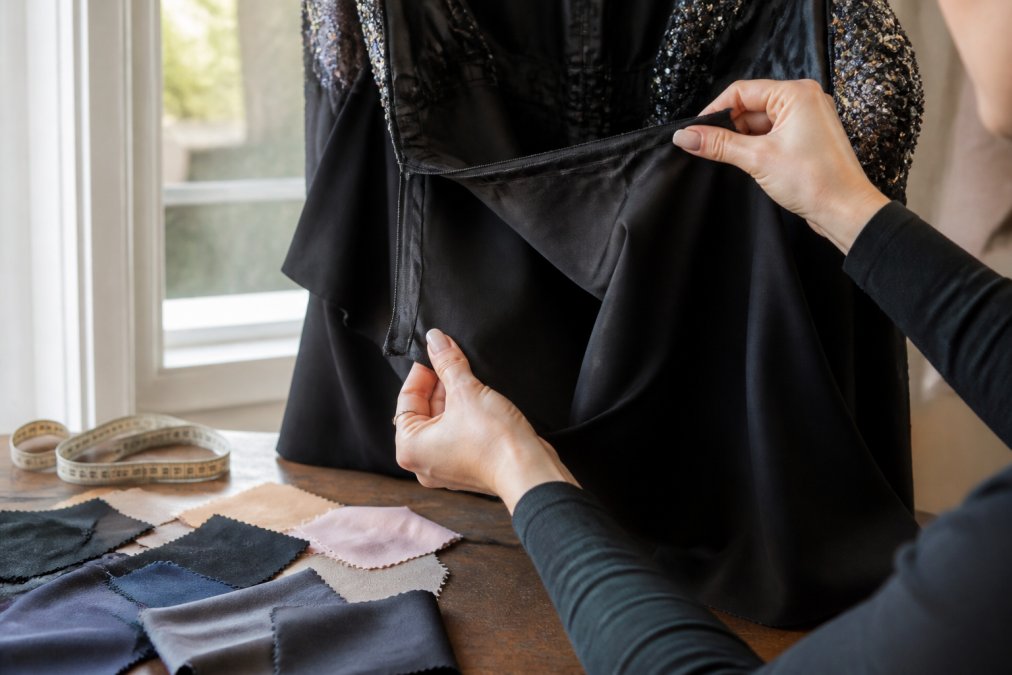
Look at the seams, the lining and the drape before the price. Those three separate a gown that survives a full evening from one that sags by the second hour.
Stitch Density, Seam Finishing and Drape
Stitch density is the number of stitches per centimetre along a seam; denser stitching generally means a stronger seam. Seam finishing is how raw edges are enclosed, overlocked, bound or French-seamed. Drape and hand-feel describe how the fabric falls and feels against the skin.
- Check whether the lining is attached or loose
- Look for even stitching with no puckering
- Ask for fabric weight in grams per square metre if it is not listed
- Confirm whether the hem is hand-finished or machine-rolled
Red Flags in Online Product Descriptions
Vague language is the clearest warning sign. "Premium fabric" or "luxury feel" without a fibre breakdown usually means the retailer is avoiding specifics. Missing care instructions, no close-up seam photos and no size chart with actual measurements are all worth noting before you add to cart.
Atelier-Grade Craftsmanship Explained: What You Are Actually Paying For
Atelier-grade craftsmanship means finishing associated with a small workroom: structured interlining, matched pattern alignment, reinforced seams and a considered fit through the bodice. You are paying for labour and time, not just cloth.

Return Policies Side by Side: Established Boutiques vs Emerging Retailers
Return terms vary more than fabric quality does, and the variation is where money quietly disappears. Established boutiques often publish polished policy pages with strict windows and formal processes. Emerging retailers frequently advertise longer windows but leave the mechanics, who pays, how long a refund takes, whether a restocking fee applies, buried in fine print or a linked PDF.
| Policy Element | Typical Established Boutique | Typical Emerging Retailer |
|---|---|---|
| Return window | 14-21 days from delivery | 14-30 days from delivery |
| Restocking fee | Sometimes applied, often 10-20% on sale items | Rarely applied, but increasingly common on discounted stock |
| Return shipping | Customer pays; label may be provided at cost | Varies; some provide prepaid labels, many do not |
| Condition requirement | Unworn, tags attached, original packaging | Unworn, tags attached; packaging rules vary |
| Refund timing | 10-14 business days after inspection | 5-14 business days after inspection |
| Exchange option | Often offered as an alternative to refund | Frequently the default remedy |
| International returns | Customer covers both directions; duties not refunded | Same pattern, but less clearly stated |
The Hidden Costs of Returning a High-End Dress
On a mass-market return, postage might cost a few dollars and the retailer often absorbs it. On a high-end gown, the economics are different:
- Return postage on a structured gown can run well into double digits because of volumetric weight, insurance requirements and the need for tracking. A boxed evening dress is not a padded satchel.
- Restocking fees on discounted or made-to-order items can erode a meaningful share of the refund. A 15% fee on a $400 gown is $60 before you have paid a cent in postage.
- Duties and taxes paid on import are generally not refunded when you return an item, even if the retailer refunds the garment price in full. That is a sunk cost.
- Insurance and signature-on-delivery are often mandatory for high-value returns, adding cost and administrative friction.
- Inspection disputes are more common on high-end items because the condition bar is higher, a single pulled thread or missing tag can turn a refund into a credit note.
How to Compare Return Policies Like a Buyer, Not a Browser
Open the policy page for each retailer you are considering and score them against five questions.
- How many days do I have, counted from delivery or from dispatch?
- Who pays return shipping, and is a prepaid label offered?
- Is there a restocking fee, and does it apply to sale or made-to-order items?
- What condition must the item be in, and is original packaging required?
- How long until the refund lands, and is it refunded to the original payment method?
Where the Two Categories Genuinely Differ
The real divergence is not the length of the window but the friction. Established boutiques tend to have formal, predictable processes, you know what will happen, even if it costs you. Emerging retailers often have faster refunds and more flexible windows, but the process can be less defined, and the burden of proof on condition can fall more heavily on you.
Off-Shoulder Lace Wedding Dress →
Australian Consumer Law Clothing Returns: Your Rights When Shopping Online
Australian Consumer Law clothing returns give you a remedy when an item is faulty, significantly different from its description, or unfit for purpose. You are then entitled to a repair, replacement or refund, and the retailer cannot push you to accept a credit note instead.
Fabric Performance Testing and Sustainability: The Trade-Offs Nobody Explains
Most guides tell you to "check the quality" and stop there. Here are tests you can run when the dress arrives, plus the sustainability trade-offs behind the fibre label.
Four Tests You Can Run in Two Minutes
Fabric performance testing measures how a textile behaves in real conditions: pilling resistance, colourfastness, seam slippage and shrinkage. Retailers rarely publish these results, so test the garment yourself before you commit to keeping it.
- The crush test. Take a section of the fabric in your fist, squeeze firmly for a few seconds, then release. A quality natural fibre or a well-woven blend will spring back with few creases. A low-grade synthetic or a loosely woven cloth will hold deep, sharp creases. This is a rough proxy for wrinkle recovery, which matters most on structured gowns.
- The light test. Hold the fabric up to a window or a lamp. If you can see your hand clearly through the shell, the weave is thin and the garment will likely need a full lining to be wearable. If the light is diffused and you cannot make out detail, the weave is denser.
- The rub test. Rub a hidden inner seam against a white tissue or cloth for ten seconds. Any colour transfer suggests poor colourfastness, which is a problem for a garment you may need to clean.
- The stretch-and-recover test. Gently pull a small section of the fabric along the grain and release. It should return to shape. If it stays stretched, the garment will bag at the knees, seat or elbows over an evening.
What Care Instructions Reveal About Performance
A care label is a performance summary in disguise. "Dry clean only" with no further detail often means the manufacturer has not tested for home care, while specific temperature, cycle and drying guidance usually signals wash testing. Specificity signals testing; vagueness signals avoidance.
The Sustainability Trade-Off Nobody States Plainly
Sustainability adds a layer most comparisons ignore. Natural fibres such as merino wool and silk biodegrade more readily and feel better against the skin, but are more delicate and need careful care. Synthetics such as polyester are durable, hold shape and resist wrinkling, but carry a heavier production footprint and do not biodegrade.
Conclusion
The gap between luxury dress boutiques and emerging high-end retailers comes down to construction detail, label transparency and return terms, not the price on the tag. Read the fibre breakdown, check the seams, and know who pays return shipping before you commit.

Frequently Asked Questions
What should shoppers look for when assessing fabric quality online?
Check the fabric composition first. Natural fibres such as merino wool, silk and cotton behave differently from synthetic materials like polyester, and the listing should state the exact blend rather than vague terms. Look for details on lining, interlining and seam finishing, because these affect how a garment holds shape and feels against the skin. If a product page shows stitch density, drape and hand-feel, or close-up construction photos, that is a good sign the retailer knows its textile quality. Ask for measurements when sizing is unclear.
How do return policies differ between established luxury brands and emerging retailers?
Established boutiques often offer shorter return windows and may charge restocking fees or return shipping on sale items. Emerging high-end retailers tend to compete on convenience, offering longer windows and clearer return shipping terms. Under Australian Consumer Law, both must provide a remedy if an item is faulty, significantly different from the description, or unfit for purpose, regardless of their stated policy. Always read the return window and unworn condition requirements before ordering, especially for international purchases.
What are my rights for online fashion returns under Australian Consumer Law?
Australian Consumer Law guarantees a remedy when goods are faulty, do not match the description, or fail to do what they are supposed to do. You can choose a refund or replacement for a major failure. This right sits alongside any voluntary store policy, so a retailer cannot override it with a shorter return window. For change-of-mind returns, the store sets its own rules, which is why checking the return window and whether return shipping is covered matters before you buy.
Are emerging high-end retailers offering better value than traditional luxury boutiques?
It depends on what you weigh. Emerging retailers often price lower because they carry less overhead, but the price-to-value ratio comes down to fabric composition, garment construction and customer satisfaction, not the label alone. A dress with dense stitching, full lining and a considered drape can outperform a costlier piece with lighter construction. Compare the fabric details and the return terms side by side, then decide which trade-off suits how you will wear the garment.