

Table of Contents
- Renting vs Buying Designer Formal Dresses: The Financial Reality
- Pros and Cons of Renting Formal Dresses
- Designer Dress Hire Cost Comparison: Rental vs Purchase
- Fit, Alterations, and the Hidden Cost of Returns
- Designer Dress Rental Insurance and Damage Policies
- Sustainability and Wardrobe Rotation
- When Buying Makes Sense: Investment Pieces and Occasion Suitability
- Conclusion
- Frequently Asked Questions
Last Updated: September 24, 2026
Renting vs Buying Designer Formal Dresses: The Financial Reality
When considering renting vs buying designer dresses, the decision goes far deeper than upfront price. Hidden expenses, fit complications, and long-term value considerations determine the true cost.
Neither option is universally better; it depends on your situation, body type, and event frequency. Understanding the real trade-offs, not just sticker prices, is what matters.
A poorly fitting rental arriving days before your event creates stress. A dress you own but never wear sits gathering dust. Both feel like a loss.
Pros and Cons of Renting Formal Dresses
Renting appeals for one-time events, but convenience comes with real limitations.
Renting works best when:
- You attend formal events infrequently (once every 1-2 years)
- You prefer variety and don't want the same dress twice
- Your body size fluctuates and you're uncertain about fit
- You want to wear a high-end designer label without the investment
Advantages: Access to luxury labels at $80-150 versus $800 to buy. You avoid storage and maintenance. For one-off occasions, this makes financial sense.
Disadvantages: Fit guarantees are theoretical with narrow return windows. Alterations are basic hemming only; custom tailoring costs extra. Damage waivers protect the company more than you; small stains or loose seams trigger charges. Shipping delays leave no time to fix fit issues.
Renting optimises for cost, not confidence. You're hoping the dress fits, arrives on time, and nothing goes wrong; hope rarely survives reality.
Designer Dress Hire Cost Comparison: Rental vs Purchase
Let's look at actual numbers, but more importantly, let's calculate the true cost of ownership for both options. A designer formal dress that rents for $120 typically costs $600-1,200 to purchase. The rental saves money upfront. But the comparison gets far more complex, and far more revealing, when you factor in everything else.
The headline comparison:
| Factor | Renting (single wear) | Buying (single wear) | Buying (3 wears over 5 years) |
|---|---|---|---|
| Upfront cost | $80-$180 | $400-$1,200 | $400-$1,200 |
| Alterations | Often extra or limited ($0-$100) | Your cost ($50-$200) | $50-$200 |
| Shipping | Usually included | Included | Included |
| Damage waiver/insurance | $15-$40 extra | Your responsibility | Your responsibility |
| Professional cleaning after event | Rental company | Your cost ($15-$30) | $15-$30 per wear = $45-$90 |
| Storage (wardrobe space, garment bags) | None | Minimal ($0-$50/year) | $0-$150 over 5 years |
| Potential repairs (seams, zippers, beads) | Covered or charged separately | Your cost ($0-$100 over time) | $0-$100 |
| Total cost per wear | $95-$220 | $500-$1,580 (1 wear) | $165-$530 (3 wears) |
Most guides compare headline prices ($120 rental vs. $800 purchase) and declare renting the winner, ignoring the real cost structure of ownership.
Professional cleaning: Formal gowns require dry cleaning after each wear at $15-30 per cleaning. Three wears over five years = $45-90.
Alterations: Buying lets you control fit through tailoring ($50-200 total). Rental alterations are basic hemming only; you fit the dress, not vice versa.
Storage: Proper storage requires a garment bag ($20-50) and climate-controlled space. This is a minor cost but real, especially in urban areas.
Repairs: Budget $50-100 over five years for seam repairs, zipper replacement, or reattaching beads.
The crossover point, where buying becomes cheaper:
Let's model three realistic scenarios:
Scenario A: One formal event every 2 years (2.5 events over 5 years)
- Renting: 2-3 rentals × $120 + $30 (waiver) = $300-390
- Buying: $800 + $100 (alterations) + $75 (cleaning) + $50 (storage/repairs) = $1,025
- Winner: Renting by $635-725
Scenario B: One formal event per year (5 events over 5 years)
- Renting: 5 rentals × $120 + $30 (waiver) = $750
- Buying: $800 + $100 (alterations) + $150 (cleaning) + $100 (storage/repairs) = $1,150
- Winner: Renting by $400
Scenario C: Two formal events per year (10 events over 5 years)
- Renting: 10 rentals × $120 + $30 (waiver) = $1,500
- Buying (2 dresses): $1,600 + $200 (alterations) + $300 (cleaning) + $200 (storage/repairs) = $2,300
- Winner: Buying by $200-400 if you restyle dresses across occasions
Scenario D: Damage incident
- Renting with damage charge: 5 rentals × $120 + $30 (waiver) + $200 (damage charge) = $950
- Buying: $800 + $100 (alterations) + $150 (cleaning) + $100 (storage/repairs) = $1,150
- Winner: Renting by $200
But you own the dress at the end. The damage charge is a sunk cost; the repair cost is an investment in a piece you'll wear again.
The real decision framework:
Renting makes financial sense if:
- You attend formal events fewer than twice per year
- You genuinely want variety and won't wear the same dress twice
- You're confident the dress will arrive on time and fit without issues
- You're willing to accept the risk of damage charges
Buying makes financial sense if:
- You attend formal events twice or more per year
- You have a stable body size and know what fits you
- You value owning pieces you can style multiple ways
- You want to eliminate the risk of damage charges and rental company disputes
MISTY'S investment pieces: Our bridesmaid dresses start at $149, with options like our one-shoulder A-line at $175.24 with sequin detailing. Choose timeless styles and neutral colours: black A-line, navy floor-length, classic silhouettes in jewel tones. These stay relevant for years; trend-dependent pieces are better suited to renting.

Fit, Alterations, and the Hidden Cost of Returns
This is where renting reveals its biggest weakness. Designer dresses are cut for specific body types. A size 10 in one brand fits completely differently than a size 10 in another. Rental services offer limited size ranges and minimal customisation.
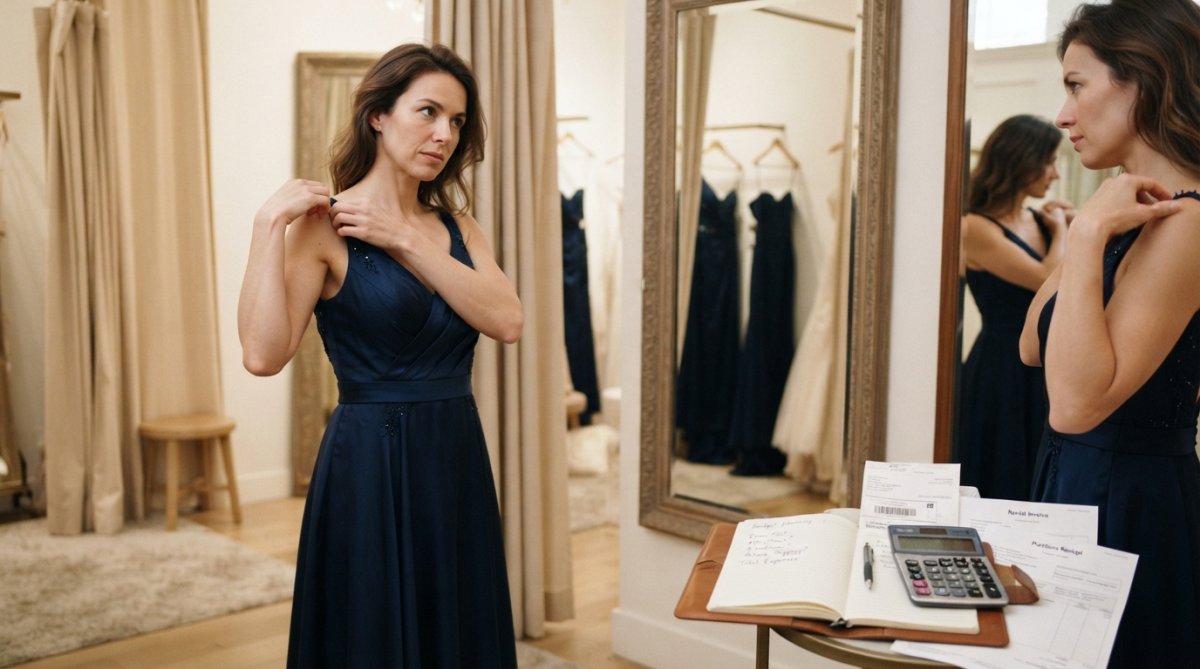
Buying lets you control alterations, taking in the waist, hemming, adjusting sleeves, transforming a dress that almost fits into one custom-made for your body. Rental alterations are basic hemming only; custom work costs extra or isn't offered.
If a rental doesn't fit, you have 48 hours to request a different size, adding 2-3 days shipping. Two weeks from your event, the second size may not fit either. MISTY'S hassle-free returns eliminate this anxiety without time pressure.
For women who fall between standard sizes or have specific body shapes, broader shoulders, smaller bust, longer torso, renting becomes a gamble.
Designer Dress Rental Insurance and Damage Policies
Real-world damage scenarios and costs:
- Scenario 1: Small wine stain on the hem. Covered under the waiver. You pay $150 total. No additional charge.
- Scenario 2: Loose sequins (3-5 missing). Most waivers cover this. You pay $150 total.
- Scenario 3: Small tear in the lining (not visible when wearing). Covered under the waiver. You pay $150 total.
- Scenario 4: Broken zipper. This is where it gets expensive. Many waivers classify zipper damage as "structural damage." The rental company charges $200-400 for replacement. Your waiver may not cover it, or may cover it with a $50-100 deductible. You end up paying $150 (rental + waiver) + $100-300 (damage charge) = $250-450 total.
- Scenario 5: Large tear in the skirt (approximately 5-8 cm). Not covered by standard waivers. You're liable for repair costs, typically $150-300, or replacement cost if repair isn't viable. Total out of pocket: $150 (rental + waiver) + $200-400 (damage liability) = $350-550.
The hidden cost: Dispute resolution.
When to add the damage waiver (and when to skip it):
Sustainability and Wardrobe Rotation
Renting assumes dresses are worn multiple times, but many sit in warehouses. Shipping logistics add carbon footprint. MISTY'S investment pieces are designed for multiple wears across occasions. Sustainable fashion is about choosing pieces you'll actually wear multiple times.
When Buying Makes Sense: Investment Pieces and Occasion Suitability
Buying becomes the obvious choice when certain conditions align. If you attend formal events regularly, more than twice per year, buying is cheaper per wear. If you have a stable body size and know what fits you, buying eliminates fit anxiety. If you value having pieces you can style multiple ways, buying gives you that flexibility.
Conclusion
The choice when renting vs buying designer dresses depends on how often you attend formal events and what gives you confidence. Renting optimises for cost and variety but hidden costs, alterations, damage waivers, and fit anxiety often eliminate savings. Buying optimises for confidence, customisation, and long-term value. If you attend formal events more than once every two years, buying makes financial and practical sense.
Frequently Asked Questions
Is renting a dress cheaper than buying?
It depends on how often you wear formal attire. Rental typically costs 20-40% of the retail price for a single event, making it cheaper for one-off occasions. However, if you attend multiple formal events yearly, buying a versatile designer piece and rotating it through your wardrobe often becomes more economical over time. Consider your cost-per-wear: if you wear a dress three or more times, buying usually wins financially.
How does the fit and alteration process differ between renting and buying?
When you buy, alterations are yours to keep, hemming, taking in, or adjusting the dress permanently improves its fit for your body. Rental services typically allow minor alterations only, and you're responsible for restoring the garment to original condition. Rental fit guarantees are limited; if a dress doesn't fit, you may have to pay a restocking fee or lose your rental fee entirely. Buying gives you control; renting limits your options.
Is renting more sustainable than buying new formal wear?
Renting reduces fashion footprint by keeping high-end garments in rotation rather than in landfill. However, frequent courier delivery, dry cleaning chemicals, and the energy cost of garment logistics offset some environmental gains. Buying one quality investment piece and wearing it multiple times is equally sustainable, or more so, than renting repeatedly. The most sustainable choice is buying atelier-grade pieces designed to last, like MISTY'S bridesmaid dresses, which you can rewear for years.