

Last Updated: October 24, 2026
Quick Summary
To find a custom fit gown, start with the occasion, venue, season and dress code, then match the silhouette to that brief before choosing fabric or design. Made-to-order gowns are built to your measurements, so measure carefully, vet the designer's construction and references, and allow a timeline with a two-week buffer.
- Write down the dress code, venue, season and standing time before looking at sketches.
- Measure twice on different days and size up if you fall between sizes.
- Ask who makes the gown, what the deposit covers and how many fittings are included.
- Request close-up photos of lining, boning, seam finish, hem depth and fastenings.
- Book your final fitting at least a week before the event with a two-week buffer.
Table of Contents
- Start With the Occasion, Then the Silhouette
- Made-to-Measure Evening Gowns vs Ready-to-Wear
- How to Measure for a Dress Without Getting It Wrong
- Questions to Ask a Dress Designer Before You Pay a Deposit
- Budget, Contract Terms and Realistic Timelines
- Fittings, Custom Gown Alterations and Remote-Fit Risks
- Order Your Custom Fit Gown With Confidence
- Frequently Asked Questions
Start With the Occasion, Then the Silhouette
The fastest way to find a custom fit gown is to work backwards from the event, not forwards from a Pinterest board. A black-tie gala, a garden wedding and a formal dinner all demand different fabrics, hemlines and structure. Get the occasion wrong and even a flawless fit feels off.
So before you look at a single sketch, write down four things: the dress code, the venue, the season, and how long you'll be standing. A floor-length silk gown that photographs beautifully can be a misery across six hours on your feet.
Then match the silhouette to that brief:
- Mermaid: dramatic entrances, structured fabric, best for photos
- A-line: forgiving, comfortable, suits almost every body type
- Ball gown: formal galas and black-tie weddings
- Sheath: cocktail events and modern city venues
If you're still deciding, our guide to evening gown silhouettes for different body types breaks down which shapes flatter which frames. You can also check evening gown trends for the 2026 formal season if you want your gown to feel current rather than timeless.
A common mistake is choosing the dress first and the shoes second. Heel height changes your posture, your hem length and your measurements. Lock it in early.
Made-to-Measure Evening Gowns vs Ready-to-Wear
Made-to-measure evening gowns are cut to your body measurements, while ready-to-wear gowns are cut to a standard size chart. That's the whole difference, and it explains almost every fit problem you've ever had.
Ready-to-wear works when you're close to the sample size. It fails when your bust, waist and hips sit in different size brackets, which is most women. A dressmaker can alter a ready-to-wear gown, but only so far before the seams and structure start to fight back.
Made-to-order sits in between. You choose a design, supply your measurements, and the gown is built for you. Bespoke or couture goes further again: a pattern drafted from scratch, often with fittings along the way.
Here's the honest trade-off:
| Option | Fit quality | Timeline | Flexibility |
|---|---|---|---|
| Ready-to-wear | Standard sizing | Immediate | Returns, if unworn |
| Made-to-order | Built to your measurements | Weeks | Limited changes after order |
| Bespoke/couture | Drafted from scratch | Months | Multiple fittings |
research on fit perceptions of customised garments in the Research Journal of Textile and Apparel looked at how people judge the fit of customised clothing, and it's a useful reminder that "custom" and "comfortable" aren't automatically the same thing. Fit perception depends on expectation as much as measurement.
How to Measure for a Dress Without Getting It Wrong
To measure for a dress accurately, wear light clothing, stand straight, and use a soft tape held snug but not tight. Ask someone else to read the numbers. Self-measuring is where most errors creep in.
You need five numbers:
- Bust: around the fullest part, tape level under the arms
- Waist: the natural crease when you bend sideways
- Hips: the fullest point, usually 18-23cm below the waist
- Height: barefoot, heel to crown
- Hollow-to-hem: from the dip at the base of your throat to where you want the hem
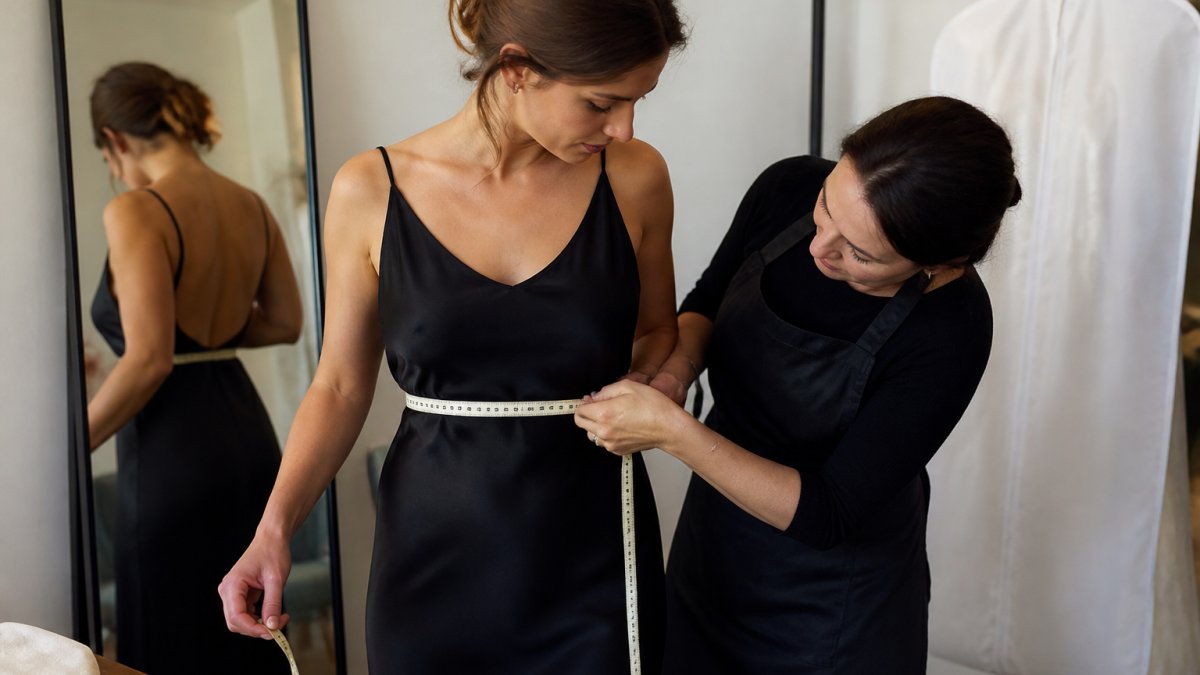
Three rules that save returns:
- Measure twice, on different days.
- Never measure over jeans or a padded bra you won't wear.
- If you fall between sizes, size up. Taking in is easy; letting out is not.
Watch out: measuring yourself in a mirror twists your torso and adds centimetres to your waist. Get a second pair of hands.
Questions to Ask a Dress Designer Before You Pay a Deposit
Ask any dress designer five things before money changes hands: who actually makes the gown, what happens if it doesn't fit, what the deposit covers, how many fittings are included, and what the final deadline is in writing.
That list separates a real dressmaker from a reseller with a nice Instagram grid. A designer who hesitates on any of them is telling you something.
But questions alone don't vet a designer. Work through four checks in order, and don't pay a deposit until all four pass.
1. Read the portfolio for range, not just highlights. Look for at least three gowns in a similar silhouette and fabric weight to what you want, plus one or two that are clearly different. A portfolio of only one silhouette may mean the maker has one pattern they tweak. Ask which gowns were made to measure versus altered ready-to-wear, the two are often photographed identically.
2. Inspect construction, not just the outside. Request close-up photos or an in-person viewing of the inside of a finished piece. Check for:
- Lining: fully lined versus partially lined, and whether the lining is attached at the waist or free-hanging
- Boning and structure: where the support sits and whether it is sewn into a stable seam
- Seam finish: overlocked, bound or French seams, bound and French seams last longer and sit flatter
- Hem: depth of the hem allowance, which determines how much length can be let down later
- Fastenings: invisible zip quality, hook-and-eye placement, and whether a corset back has a modesty panel
A maker who can't or won't show the inside is usually hiding something.
Verona One-Shoulder Mermaid Bridal Gown with Corset Back →
3. Check reviews and references properly. Read reviews for patterns, not stars: late delivery, poor communication and fit complaints often appear in the text of otherwise positive reviews. Ask for two recent client references and contact them. Good questions: Did the gown arrive on the agreed date? How many fittings did it take? Were alterations included or charged extra? Would you use them again?
4. Test communication before you commit. Send two or three specific questions by email and note the response time and whether the answers are specific. Vague or slow replies before a deposit rarely improve after one.
Then go deeper with these:
- Can I see examples of your construction, not just finished photos?
- Which fabrics do you recommend for my venue and season?
- What's your policy if the gown arrives late?
- Who handles alterations, and are they included in the quote?
- Can I speak to a recent client?
What most guides miss is the construction question. Lining, boning and seam finish decide whether a gown holds its shape at midnight or collapses by dessert. Ask to see the inside of a finished piece.
Budget, Contract Terms and Realistic Timelines
Set your budget before you fall in love with a design, and build in a cushion for alterations. Alterations are the line item almost everyone forgets, and they're rarely free.
What drives the price. Custom gown costs move with four things: fabric (silk and heavy beading cost far more than crepe or jersey), construction complexity (boning, corsetry, hand-finishing), personalisation (beading, embroidery, appliqué), and the number of fittings. Ask for the quote broken down by these categories so you can see where to trade off.
Deposits and payment schedules. A deposit is normal, but it should be a defined percentage of the total and tied to a written delivery date. Ask:
- What percentage is the deposit, and is it refundable?
- When are the balance and any progress payments due?
- Are alteration fees included, capped, or charged hourly?
- What is the cancellation and postponement policy?
- What happens if the gown is delivered late, is there a remedy?
Get the quote in writing and check it covers:
- The gown itself, with fabric named
- Any personalisation or beading
- Fittings and alterations
- Shipping and delivery dates
- The refund and cancellation policy
A realistic milestone timeline. Work backwards from your event date and leave contingency at every stage:
| Milestone | Typical lead time before the event |
|---|---|
| Designer research and consultations | 6-9 months |
| Deposit and measurements | 5-8 months |
| First fitting | 8-12 weeks |
| Second fitting (bespoke) | 4-6 weeks |
| Final fitting and alterations | 1-2 weeks |
| Buffer for delays | At least 2 weeks |
A made-to-order gown typically needs several weeks from order to delivery, and bespoke work with fittings can run into months. If your event is three weeks away, be honest with yourself about what's achievable, a well-altered ready-to-wear gown is often the better answer than a rushed custom order.
Watch out: a deposit that isn't tied to a written delivery date gives you very little use. Ask for the deadline in the contract, not in a message thread.
Fittings, Custom Gown Alterations and Remote-Fit Risks
Custom gown alterations are where a good gown becomes a great one. Expect at least one fitting for made-to-order, and two or three for bespoke work. Each fitting should tighten the fit at the bust, waist and hem.
Remote fitting carries real risk. You're trusting your own measurements and someone else's pattern. That's workable, but only if you measure carefully, share your height and heel height, and confirm the size chart before ordering.
Our guide for online shoppers on evening gown alterations walks through what to expect and how to plan for adjustments.
One insider tip: book your final fitting at least a week before the event. Last-minute alterations are rushed, and rushed alterations show.
Order Your Custom Fit Gown With Confidence
The difference between a gown that works and one that doesn't comes down to preparation: the right silhouette for the occasion, honest measurements, a designer who answers hard questions, and a timeline with room to breathe.
At MISTY'S, we build our evening wear around atelier-grade craftsmanship, worldwide shipping and an easy returns policy, so you can order with a safety net. Our Verona one-shoulder mermaid bridal gown has a corset back you can cinch to your own shape, and our Aveline mesh trail dress uses an adjustable strap system for a pressure-free fit. Browse the full evening wear collection to see what's available.


Frequently Asked Questions
How do I find a designer gown that fits my body?
Start with accurate bust, waist and hip measurements taken over the underwear you plan to wear, then compare them against the designer's own size chart rather than your usual retail size. Bridal and structured fabrics often run one to two sizes smaller than standard retail brands, so if you sit between sizes, choose the larger one. A corset or adjustable strap back, like the Verona one-shoulder mermaid gown, lets you cinch the bodice to your shape instead of relying on a fixed size.
How far in advance should I order a custom fit gown?
Allow at least two to three weeks for shipping and any custom gown alterations once it arrives. If your event is three weeks away, a ready-to-wear piece with an adjustable back is the safer route, since there is no time to remake a bodice.
Can a designer gown be altered after it arrives?
Yes, most gowns can be taken in at the waist, shortened at the hem and adjusted through the bodice, but the amount of fabric in the seams limits how much. Structured fabrics such as heavy lace and polyester weaves hold their shape well but leave little room to let out. Corset-back styles need fewer changes because the lacing adjusts the fit.
What should I ask a designer before ordering a custom gown?
Ask what the quoted price includes and what happens if the finished gown does not match the agreed measurements. Request the fabric composition and a swatch, the delivery date in writing, and the deposit and cancellation terms.
Finding a gown that fits properly shouldn't feel like a gamble. Get started with MISTY'S and order a gown built to make you feel confident from the first photo to the last dance.
