
Table of Contents
- Understanding Why Online Dress Returns Happen
- Online Clothing Sizing Tips: Master the Sizing Chart
- How to Measure Yourself for Online Clothes Accurately
- Fabric Guide for Online Shopping: Know What You're Buying
- Virtual Try-On Apps for Dresses: Leverage Technology to Reduce Returns
- Detailed Product Descriptions and Customer Reviews: Your Best Tools to Avoid Returns
- Proven Strategies to Avoid Online Dress Returns Before You Buy
- Sustainable Solutions for Non-Returnable Items
How to Avoid Online Dress Returns: 7 Proven Strategies
Last Updated: July 21, 2026
Online shopping for dresses should be exciting, not stressful. Yet many shoppers find themselves caught in a cycle of ordering, returning, and reordering. Learning how to avoid online dress returns starts with understanding that the problem isn't the dresses themselves; it's the gap between what you see on a screen and what arrives at your door. At MISTY'S, we've spent years helping fashion-forward customers navigate this challenge by providing detailed product information, accurate sizing guidance, and transparent return policies. Below, we'll show you exactly how to avoid online dress returns through seven proven strategies.
Understanding Why Online Dress Returns Happen
The biggest reason online dresses get returned is fit. When shoppers can't try on a garment before purchasing, they're making an educated guess. Many assume their usual size will work across all brands, only to discover that sizing varies dramatically between retailers.
Beyond sizing, shoppers return dresses because product descriptions lack critical details. A photo showing a dress from the front tells only part of the story. You can't see how fabric drapes in motion, whether it clings to curves or flows freely, or if the back neckline matches the front.
Fabric composition also plays a hidden role. A dress listed as "100% polyester" behaves completely differently from one that's "60% cotton, 40% polyester." Polyester clings and shows every bump; cotton breathes and forgives. Many shoppers don't realize this difference until the dress arrives.
Online Clothing Sizing Tips: Master the Sizing Chart
Stop assuming your size. Every brand uses different sizing standards. A size 8 at one retailer might be a size 10 at another. The only way to know is to consult the brand's specific sizing chart before you buy. According to research from the National Retail Federation's 2026 Fashion Report, accurate sizing information reduces return rates by up to 40% when customers use detailed measurements rather than relying on standard sizes alone.
Compare Multiple Size Sources
Don't rely on a single size recommendation. Check three sources before deciding:
-
The brand's official sizing chart. Look for measurements in inches or centimeters for bust, waist, hip, and length. Compare these directly to your own measurements, not to the size label.
-
Customer reviews mentioning fit. Read reviews from people with similar body types to yours. If a reviewer says "I'm usually a size 8 and this runs small, I sized up to a 10," that's actionable intel.
-
The product description's fit notes. Some brands include statements like "This dress has a relaxed fit" or "Runs true to size."
If all three sources agree the dress runs small, size up. If they conflict, go with the brand's official chart as your tiebreaker.
Account for Fabric Stretch and Shrinkage
Fabric composition determines how a dress will fit after you wear it. Natural fabrics like cotton and linen shrink in the wash, typically 2-5% depending on care. Synthetic fabrics like polyester and nylon don't shrink, but they stretch with wear and body heat.
Check the care instructions before you buy. If the label says "dry clean only," the dress likely won't shrink. If it says "machine wash," assume some shrinkage unless the fabric is 100% synthetic.
How to Measure Yourself for Online Clothes Accurately
Accurate body measurements are your insurance policy against returns. Most people measure themselves wrong the first time.
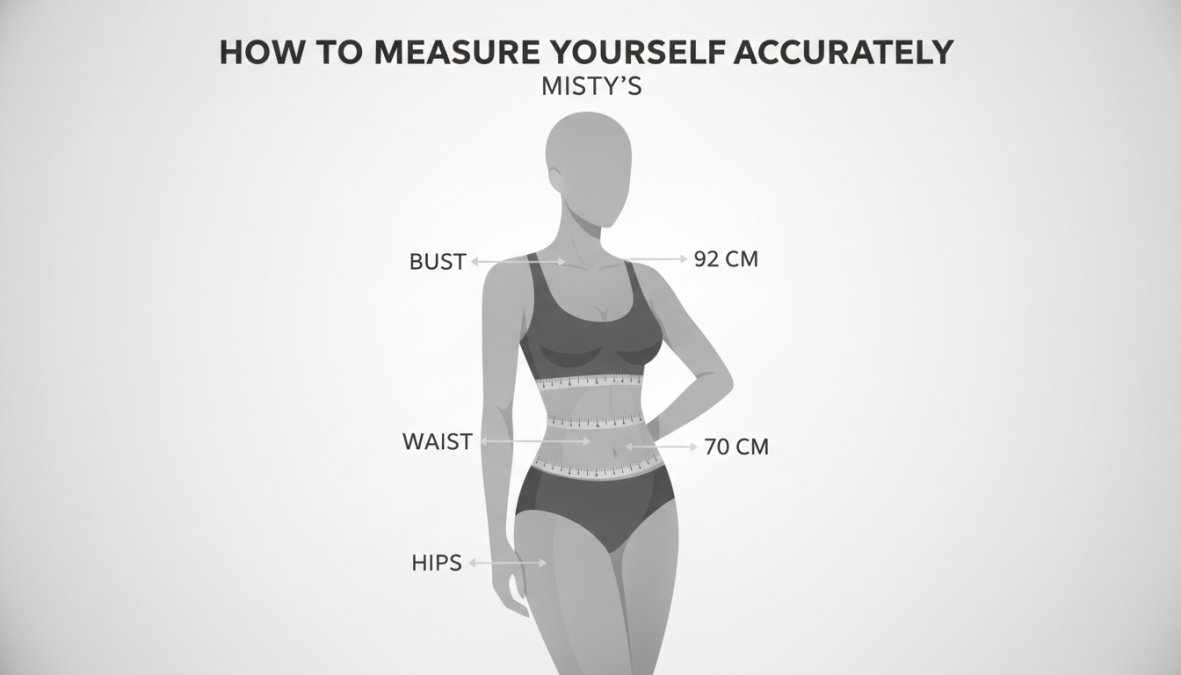
Essential Measurements You Need
You need four core measurements for dresses: bust, waist, hip, and length.
Bust: Measure around the fullest part of your chest, keeping the tape parallel to the ground. Don't pull tight; the tape should be snug but not compressing your chest. Wear an unpadded bra for accuracy.
Waist: Measure around your natural waist, the narrowest part of your torso, usually about an inch above your belly button. Keep the tape snug but not tight.
Hip: Measure around the fullest part of your hips and thighs, usually 7-9 inches below your waist. Keep the tape level and parallel to the ground.
Length: For dresses, measure from your shoulder to your knee (for knee-length dresses) or to your ankle (for full-length dresses). Stand straight, and have someone help if possible.
Common Measurement Mistakes to Avoid
The most common mistake is measuring over clothing. Always measure against bare skin or in a thin, fitted shirt. Another error is pulling the tape too tight. Your measurements should feel comfortable, not restrictive.
Some shoppers measure themselves standing in a slouch or with one shoulder higher than the other. Stand up straight with your feet together and arms at your sides. Finally, don't measure just once. Measure twice on different days and average the results for a more reliable number.
Fabric Guide for Online Shopping: Know What You're Buying
You can't touch fabric through a screen, but you can learn to read fabric composition labels and understand how different materials behave on your body.
Reading Fabric Composition Labels
Every dress listing includes a fabric composition, usually as a percentage breakdown. This tells you everything about how the dress will fit, feel, and last.
100% natural fiber (cotton, linen, silk, wool): These breathe beautifully but wrinkle easily and may shrink 2-5% unless pre-shrunk. They're ideal for casual dresses and warm climates.
100% synthetic (polyester, nylon, acrylic): These don't wrinkle, don't shrink, and are easy to care for. They're less breathable and can feel plastic-like if low-quality. They stretch with wear and body heat.
Blends (e.g., 60% cotton, 40% polyester): These combine breathability with durability and reduced wrinkles. Blends shrink less than pure natural fibers.
Stretch fabrics (anything with spandex or elastane): Even 2-5% spandex adds significant stretch. A dress with spandex will hug your curves more and move with your body.
Read the full composition before buying. If a dress is "100% polyester," it will cling to your body. If it's "100% linen," it will wrinkle but breathe beautifully. If it's "70% cotton, 25% polyester, 5% spandex," it balances breathability, durability, and stretch.
How Fabric Affects Fit and Appearance
Fabric choice changes how a dress looks on your body. Heavy fabrics (thick cotton, linen, wool blends) drape and hide imperfections. They're forgiving and ideal if you want a dress that doesn't cling. Light fabrics (thin polyester, silk, rayon) show every contour and are ideal if you want to show off your shape. Stretchy fabrics (with spandex) move with your body and feel comfortable, though they show your shape more than non-stretch fabrics.
Virtual Try-On Apps for Dresses: Use Technology to Reduce Returns
Virtual try-on technology has evolved dramatically. Several brands and retailers offer AI-powered sizing tools that use your measurements and body shape to predict how a dress will fit.
These tools work by asking you to input your measurements or answer questions about your body shape. The algorithm then predicts how the dress will fit based on thousands of data points from other customers with similar measurements. Some apps even let you upload a photo and see how the dress would look on your body type.
The limitation is that virtual try-ons are only as good as the data behind them. If the app doesn't have enough customer feedback data for a specific dress, the prediction becomes less reliable. Still, using a virtual try-on before you buy is better than guessing. Research from Digital Fashion Pro's 2026 Virtual Try-On Study found that customers who used virtual try-on tools returned dresses 28% less frequently than those who didn't.
Detailed Product Descriptions and Customer Reviews: Your Best Tools to Avoid Returns
The quality of a product description directly correlates with return rates. Vague descriptions lead to returns; detailed descriptions reduce them.
What to Look for in Product Descriptions
A good product description answers the questions you're actually asking: How will this fit? How does it look in person? What's it made of? When would I wear this?
Look for descriptions that include fit language ("Relaxed fit," "Slim fit," "Flowing"), length information ("Hits at the knee," "Midi length"), neckline and sleeve details, closure type, care instructions, and fabric feel description ("Soft and breathable," "Lightweight and flowy").
At MISTY'S, we include all of these details because we know they matter. A dress with a detailed description is far more likely to be a keeper than one with a vague one.
How to Read Reviews for Honest Fit Feedback
Customer reviews are goldmines of information, but you have to read them strategically. A review that says "Runs small" is useless without context. A review that says "I'm usually a size 8, 5'6", 150 lbs, and this dress was too tight in the hips even in a size 10" is actionable.
Look for reviews from people who share your body type, height, and size. Pay attention to reviews that mention specific fit issues: "Gapped at the bust," "Too loose in the waist," "Shorter than expected," "Clung to my belly." Ignore reviews that are purely about quality or style. If multiple reviewers mention the same fit issue, take it seriously.
Proven Strategies to Avoid Online Dress Returns Before You Buy
Beyond sizing and reviews, there are tactical strategies that dramatically reduce the chance you'll need to return a dress.
The Bracketing Strategy: Order Multiple Sizes
Bracketing means ordering the same dress in two or three sizes, knowing you'll return the ones that don't fit. If you're between sizes or unsure how a dress will fit, ordering just one size means a 50% chance of disappointment. Ordering two sizes means you'll almost certainly get one that fits.
Yes, you'll pay return shipping on one, but you'll avoid the time and frustration of reordering. The math works out if you order from a brand with free or inexpensive returns. However, if returns cost $15 or more, bracketing becomes less attractive. Order the size you think will fit and one size up. Don't order three sizes unless you're truly unsure.
Request Detailed Photos from the Brand
Many brands have customer service teams that will send additional photos if you ask. A photo of the dress worn by a model from the back, the side, or in motion can reveal details the product photos don't show.
Send a polite email to the brand's customer service asking for additional photos. Many brands will oblige because they want to reduce returns as much as you do. This is especially valuable for formal dresses or any dress you're buying for a specific event.
Check the Return Policy Before You Buy
A generous return policy is your safety net. Before you order, read the return policy carefully. Key questions: How many days do you have to return? Is return shipping free or do you pay? Do you get a full refund or store credit? Are there restocking fees?
A brand with free returns and a 60-day window is forgiving if the dress doesn't fit. A brand that charges for returns and only allows 14 days is risky. Sometimes paying a bit more for a dress from a brand with a better return policy is worth it.
Sustainable Solutions for Non-Returnable Items
Sometimes a dress doesn't fit and you can't return it. Here's what to do instead of letting it sit in your closet.
Tailor it. A dress that's slightly too large can often be taken in by a tailor. Basic alterations typically cost $30-75 and are often worth it for a dress you love.
DIY fixes for common problems. Dresses that gap at the bust can be fixed with fashion tape or a safety pin worn on the inside. Dresses that are too loose in the waist can be cinched with a belt.
Resell it. If the dress is new or barely worn, resell it on Poshmark, Depop, Vestiaire Collective, or ThredUP. You'll recover some of your money and give the dress a second life.
Donate it. If the dress is in good condition, donate it to a local thrift store, women's shelter, or clothing bank. You'll get a tax deduction and help someone who needs it.
Online dress shopping doesn't have to be a gamble. By mastering sizing charts, understanding fabric composition, reading reviews strategically, and using tools like virtual try-ons, you can dramatically reduce the chance of ordering something that doesn't fit. When you do order, MISTY'S makes the process easier with detailed product descriptions, atelier-grade craftsmanship, and a hassle-free return policy that gives you peace of mind. Start with accurate measurements, compare multiple size sources, and order with confidence.
Frequently Asked Questions
What are the most common reasons for online dress returns?
The primary reasons include incorrect sizing due to inaccurate measurements or inconsistent size charts, fabric appearance differing from product photos, unexpected fabric texture or quality, and fit issues around the bust, waist, or length. Many retailers also see returns from customers who ordered multiple sizes (bracketing) and kept only one. Understanding these common issues helps you focus on the prevention strategies that matter most.
How can online clothing sizing tips help me avoid returns?
Online clothing sizing tips teach you to compare multiple size sources, account for fabric stretch, and measure yourself consistently. Most returns stem from sizing mismatches. By consulting detailed sizing charts, checking customer reviews for fit feedback, and measuring against the brand's specific measurements rather than your usual size, you dramatically reduce the chance of ordering the wrong size. Always cross-reference at least two size guides before purchasing.
Do virtual try-on apps for dresses actually reduce returns?
Virtual try-on tools and AI sizing apps can be helpful when used correctly, but they work best alongside other strategies. These apps use your measurements and body data to preview fit, helping you visualize how a dress will look on your frame. However, they cannot account for fabric texture, weight, or how the garment drapes in person. Use them as one data point, combined with detailed product descriptions, customer reviews, and accurate body measurements for the best results.
What should I look for in a product description to avoid online dress returns?
Look for detailed fabric composition (fiber content, weight, stretch percentage), garment measurements (bust, waist, hip, length) rather than just size labels, care instructions that indicate fabric behavior, and notes about fit (whether it runs small, large, or true to size). High-quality product descriptions from brands like MISTY'S include information about how the dress is designed to fit different body types, any lining or structure details, and styling suggestions that help you visualize the final look.
This article was written using GrandRanker