

Table of Contents
- What Sophisticated Professional Women Actually Need from Occasion Wear
- Why Petal and Pup's Aesthetic Falls Short for Timeless Occasion Wear
- Fabric Composition: The Quality Signal Most Shoppers Overlook
- How to Spot Atelier-Grade Women's Clothing Before You Buy
- Luxury Occasion Wear Brands: What Separates Them from Fast Fashion
- High-Quality Cocktail Dresses for Work Events: A Styling Guide
- Building a Capsule Wardrobe Around Timeless Occasion Wear
- Conclusion
- Frequently Asked Questions
Last Updated: September 22, 2026
What Sophisticated Professional Women Actually Need from Occasion Wear
The short answer: timeless occasion wear is clothing built to survive more than one season and more than one event, defined by structured tailoring, fully lined construction, and fabrics that hold their drape after repeated wear, a dress or suit that works at a client dinner on Thursday and a wedding on Saturday without looking tired by Sunday.
Why Petal and Pup's Aesthetic Falls Short for Timeless Occasion Wear
Petal and Pup built its reputation on a fast-fashion model: trend-led drops, lower price points, and high turnover. If you search for Petal and Pup reviews, a recurring theme in customer feedback is inconsistency between the product photo and the garment that arrives, plus fabric that feels thinner than expected.
The Fast-Fashion Model, Explained
Fast fashion compresses the time between a trend appearing and a product hitting the site: a design is sketched, sampled, and listed in weeks rather than months. That speed is only possible if the garment is simple to make, fewer panels, lighter fabric, minimal lining, and trims chosen for cost rather than longevity.
What the Australian Consumer Law Entitles You To
If a garment fails earlier than a reasonable person would expect, the Australian Competition and Consumer Commission's guidance on consumer guarantees is the relevant framework. Under the Australian Consumer Law, goods must be of acceptable quality: they must be fit for purpose, free from defects, durable, and acceptable in appearance and finish.
How to Compare a Fast-Fashion Piece Against a Timeless One
Before you buy, run these two-minute checks:
- Weight in the hand: a mid-weight fabric with body will feel substantial; a thin fabric that lets light through will crease and cling
- Lining: a fully lined bodice and skirt is a construction cost the fast-fashion model avoids; unlined garments are cheaper to make and show every seam
- Seam finish: turn it inside out. Overlocked edges on a lightweight fabric are normal; fraying, puckered, or narrow seams are a speed signal
- Hem depth: a deeper hem (3-5 cm rather than 1 cm) adds weight, improves drape, and allows alteration
- Care label: a garment that demands dry cleaning only may cost more across its life than a machine-washable piece at twice the price
The Cost-Per-Wear Calculation
The reason this matters isn't snobbery, it's arithmetic. A $120 dress worn twice costs $60 per wear; a $320 dress worn twenty times costs $16 per wear. The cheaper garment is only cheaper if you never wear it again, exactly what the fast-fashion model is designed around.
Fabric Composition: The Quality Signal Most Shoppers Overlook
Fabric composition is the most reliable predictor of how a garment will age, and it's printed on every label. Most shoppers never read it.
Here's what each fibre actually does:
- Natural fibres (wool, silk, cotton, linen): breathe well, age gracefully, but crease and need care
- Polyester and polyester blends: hold shape, resist wrinkling, and take dye evenly, which matters for deep jewel tones
- Viscose and rayon: drape beautifully but can pill and stretch over time
- Elastane (usually 2-5%): adds recovery so a slim-fit silhouette doesn't bag out at the knees
Fully Lined vs Unlined Garments: What the Label Tells You
A fully lined garment has a separate inner layer sewn throughout the bodice and skirt. The lining stops the outer fabric clinging, hides seam allowances and construction shortcuts, and makes the garment hang cleanly instead of catching on what you're wearing underneath.
Textile Durability and Drape: Why Polyester Blends Can Outperform
Drape is how a fabric falls under its own weight. Good drape means the garment moves with you and returns to shape; poor drape means it stands away stiffly or collapses into creases.
How to Spot Atelier-Grade Women's Clothing Before You Buy
Atelier-grade women's clothing is defined by construction detail you can verify, not by a label or price tag. Check these five things before you commit.
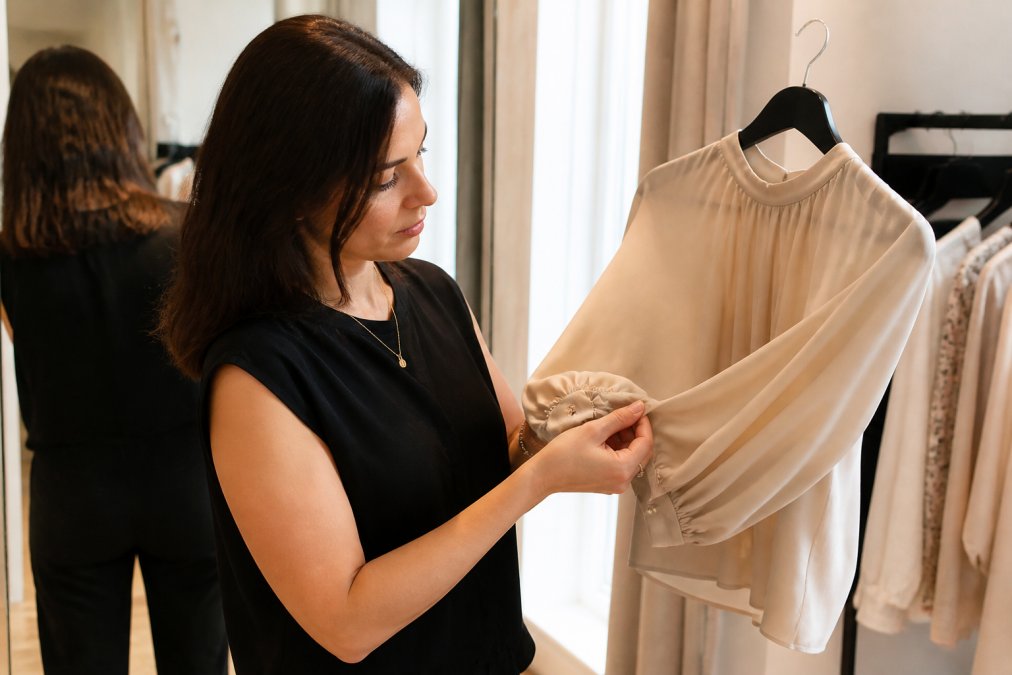
- Seam allowance: turn the garment inside out. Wide, cleanly finished seams signal care; fraying, narrow seams signal speed
- Lining: fully lined bodice and skirt, in a fabric that matches the outer weight
- Pattern matching: at the side seams and centre back, does the print or stripe line up? If not, the fabric was cut to save material
- Buttons and zips: metal or reinforced plastic, securely anchored, with a zip that runs smoothly without catching
- Hem depth: a deeper hem (3-5 cm rather than 1 cm) allows for alteration and adds weight that improves drape
Luxury Occasion Wear Brands: What Separates Them from Fast Fashion
Luxury occasion wear brands differ from fast fashion in three measurable ways: fabric sourcing, construction time per garment, and how long a design stays in the range.
Ethical and Sustainable Manufacturing Standards to Look For
Look for specific, verifiable statements rather than vague ones. "Ethically made" means nothing on its own. Useful signals include named factories, published audit results, certified fibres, and a stated position on how long workers are employed.
High-Quality Cocktail Dresses for Work Events: A Styling Guide
High-quality cocktail dresses for work events solve a specific problem: they need to read as professional at 6pm and appropriate at 9pm, without a full outfit change.
Women's Slim-Fit Two-Piece Suit Set →
| Event | Best Silhouette | Fabric Priority | Styling Move |
|---|---|---|---|
| Client dinner | Sheath or wrap dress | Structured, fully lined | Add a tailored blazer |
| Awards evening | Fit and flare midi | Drape with recovery | Statement earrings, simple heel |
| Networking drinks | Tailored two-piece | Wrinkle-resistant blend | Wear as a set, no blazer |
| Wedding guest | A-line or wrap | Lined, mid-weight | Swap office tote for clutch |
Fit-for-Purpose Styling: From Boardroom to Evening Event
The transition is about one or two changes, not a whole new outfit. A tailored blazer comes off, a structured tote becomes a clutch, and jewellery gets bolder. The base garment stays the same.
Building a Capsule Wardrobe Around Timeless Occasion Wear
A capsule wardrobe for occasion dressing needs five pieces, not fifteen. The goal is maximum combinations from minimum items, so every purchase has to earn its place, each piece should be wearable at least three ways.
Start with these:
- One tailored two-piece set in a neutral or deep colour, worn together or split across outfits
- One versatile blouse that tucks cleanly into trousers or a pencil skirt
- One midi dress in a structured fabric with a fully lined bodice
- One blazer that layers over everything above
- One pair of pointed-toe heels in a colour that matches at least three of the four garments
The Three-Wear Test: How to Vet a Piece Before You Buy It
Before a garment enters the capsule, it has to pass a simple test: can you name three distinct occasions where you'd wear it, with three different styling combinations, without buying anything new? If not, it's a one-event purchase, not a capsule piece.
Run each candidate through these questions:
- Work-to-evening: can it go from a 9am meeting to a 7pm dinner with only a jacket change and a swap of accessories?
- Seasonal range: can it be worn in at least two seasons, layered or unlayered?
- Colour logic: does it match at least two other pieces already in the capsule?
- Care reality: will you actually maintain it, or will the dry-cleaning bill stop you wearing it?
- Alteration potential: if the fit is close but not perfect, can a tailor fix it without rebuilding the garment?
Cost-Per-Wear: The Number That Actually Matters
Price tags are misleading. The useful figure is cost per wear: purchase price divided by the number of times you wear it. A $140 two-piece set worn thirty times costs about $4.67 per wear; a $70 trend dress worn twice costs $35 per wear, seven times more expensive per outing.
Work-to-Evening Transitions: The Mechanics
This is where a coordinated two-piece earns its keep. The Women's Slim-Fit Two-Piece Suit Set ($160.59) is built for exactly this: a slim-fit silhouette in a solid colour, available in Black, Apricot, Purple, Peacock Blue and Yellow, sizes M to 4XL. Wear the full set to the office, then drop the jacket for the evening.

A Worked Example: Five Pieces, Twelve Outfits
Here's how the capsule multiplies. With one two-piece set, one blouse, one midi dress, one blazer, and one pair of heels, you can build at least twelve distinct outfits for work events, client dinners, weddings, and awards nights. The set alone gives three looks (together, top with trousers, skirt with a blouse), the dress two (bare or under the blazer), and the blouse two (with the skirt or tailored trousers).
Conclusion
The real challenge isn't finding occasion wear, it's finding pieces that still look considered after the fifth wear rather than the first. That comes down to fabric composition, lining, and construction, none of which show up in a styled product photo.
Frequently Asked Questions
What should I look for when choosing between trendy and timeless occasion wear?
Prioritise garment construction and fabric quality over trend-driven details. Check whether a piece is fully lined, examine the hemline and neckline stitching, and consider whether the silhouette will still feel appropriate in three years. A sheath dress or wrap dress in a neutral colour will outlast a heavily embellished piece. Timeless occasion wear focuses on drape, tailoring and versatility rather than seasonal embellishments that date quickly.
How do atelier-grade women's clothing brands differ from fast-fashion retailers in quality and craftsmanship?
Atelier-grade women's clothing typically uses higher-durability fabrics, structured draping and precise tailoring. Fast-fashion pieces often cut corners on lining, seam finishing and textile durability. When assessing quality, look for smooth-finish polyester blends and garments designed to maintain shape through repeated wear. These construction choices affect how the piece sits on your frame and how long it lasts.
Are there Australian-based alternatives to Petal and Pup for formal events?
Yes. Several boutique fashion labels focus on atelier-grade construction rather than trend-driven volume. Look for brands that offer worldwide shipping and provide clear returns policies. MISTY'S, for example, offers tailored two-piece suit sets and structured blouses designed for professional women who need pieces that transition from office to evening events without compromising on sophistication.
What fabric compositions offer the best longevity for occasion wear?
High-durability polyester blends offer excellent wrinkle resistance and shape retention. Fully lined garments protect the outer fabric and improve drape. Look for smooth-finish textiles that resist pilling and maintain their structure after repeated wear. Polyester contributes durability and easy care. The best occasion wear combines these for a polished look that lasts.