

Table of Contents
- The Real Verdict: Pros and Cons for the Office
- What a Capsule Wardrobe Actually Is (And Isn't)
- Why Most Office Capsules Fail: 3 Common Pitfalls
- Corporate Capsule Wardrobe Essentials: The 2026 Checklist
- How to Build a Work Capsule Wardrobe in 5 Steps
- The Laundry Cycle Reality: How Many Pieces You Really Need
- Budget vs. Sustainability: What Your Investment Actually Buys
- Conclusion: Making the Capsule Decision for Your Career
- Frequently Asked Questions
Last Updated: September 7, 2026
The Real Verdict: Pros and Cons for the Office
A capsule wardrobe is a curated collection of versatile, interchangeable clothing pieces designed to maximise outfit combinations while minimising total items. For office workers, the honest answer is yes, but only if you build it around your actual workplace dress code.
A well-executed work capsule eliminates the 15-minute morning scramble and ensures you always look polished (apa.org).
What a Capsule Wardrobe Actually Is (And Isn't)
A capsule wardrobe is a small, thoughtfully edited set of clothing where every piece can be mixed and matched to create multiple outfits. It is not a uniform, nor is it a ban on colour or personality. The classic model centres on a cohesive colour palette built around neutral tones with a few accent shades.
The distinction matters because many office capsules fail when they become too restrictive. If your goal is simply to own fewer items, you will likely end up frustrated. If your goal is to build a wardrobe foundation that makes dressing for a business casual or corporate environment effortless, the capsule strategy works well.
Why Most Office Capsules Fail: 3 Common Pitfalls
The first pitfall is ignoring your actual workplace dress code. A creative agency with a smart casual policy requires a different capsule than a law firm demanding formal corporate attire.
The second mistake is prioritising trends over staple items. A capsule collection relies on tailored blazer, crisp blouses, and well-fitted trousers that survive multiple seasons.
The third and most common failure is neglecting the laundry cycle reality. Many guides suggest you need only five shirts and three pairs of trousers, which is fine in theory until you spill coffee on Monday.
Corporate Capsule Wardrobe Essentials: The 2026 Checklist
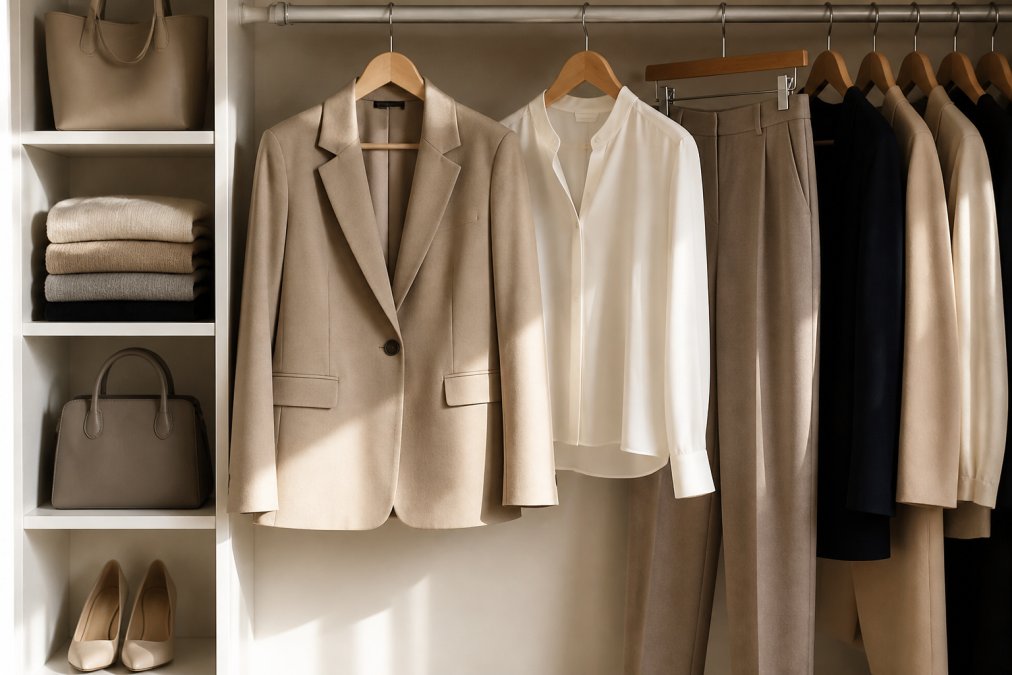
The most effective corporate capsule wardrobe essentials for 2026 revolve around a tight colour palette and pieces that transition from desk to dinner. Aim for roughly 15 to 20 items.
Foundation Pieces That Earn Their Keep
Start with two tailored blazers in neutral shades. A classic black or navy option anchors formal meetings, while a softer beige or grey version handles less rigid days. Beneath those, you need three to four blouses in silk or high-quality polyester blends that resist wrinkles. The Enchanté Notch V-Neck Nine-Point Sleeve Office Blouse at $100.00 is engineered for exactly this role.

For bottoms, two pairs of tailored trousers and one pencil skirt cover most scenarios. The High Waist Business Commute Trousers at $39.95 offer a straight-leg cut that pairs with everything, while a second pair in a contrasting neutral extends your rotation.

The Accessories That Tie It Together
Accessories carry the weight of day-to-night styling. One structured tote, one pair of understated block heels, and a silk scarf can transform the same base outfit from boardroom to after-work drinks. The Vespera Metro Urban Minimalist Commuter Tote Bag at $69.00 is designed as the anchor of this rotation, with a medium-firm structure that keeps documents organised while complementing sharp tailoring.

How to Build a Work Capsule Wardrobe in 5 Steps
Building a work capsule is a process of elimination and intention, not a shopping spree. The following framework takes roughly a weekend to complete.
Step 1: Audit Your Current Closet
Pull everything out and sort into four piles: keep, repair, remove, and 'maybe'. The keep pile should only contain items that fit well, flatter you, and align with your workplace dress code. The repair pile is for quality pieces needing minor tailoring. The remove pile includes anything you have not worn in a year. The 'maybe' pile is the trap; set a 48-hour timer and if you haven't worn it by then, it goes to remove.
A common pattern among office workers is keeping 'aspirational' pieces, items that are slightly too small or belong to a different dress code. Be ruthless. If it doesn't work with at least three other items in your keep pile, it is not a capsule piece.
Step 2: Define Your Office Dress Code
Before buying anything new, write down the actual dress expectations in your workplace. Is it strict corporate, business casual, or smart casual? This determines whether you need more suiting or can lean on separates.
Be specific. 'Business casual' at a bank means tailored trousers and a blazer; at a tech startup it might mean dark jeans and a button-down. Write down the three most common outfit formulas you see.
Step 3: Map Your Week, Not Your Fantasy
The single biggest failure point in capsule planning is ignoring the rhythm of your actual work week. Do you have back-to-back meetings on Tuesdays where you need to look sharp but also be comfortable? Do you present to clients on Thursdays?
Sketch out a typical week and assign a 'zone' to each day: formal, standard business, or relaxed. Your capsule needs to cover the most demanding day, not the average one.
Step 4: The 3-Outfit Rule for Every New Purchase
Before you buy anything, ask: can this item create at least three complete outfits with pieces already in your keep pile? If the answer is no, it does not belong in your capsule.
For example, a silk blouse in a neutral tone like ivory or champagne will pair with your black trousers, your navy skirt, and your grey blazer, that is three outfits. A bright red blouse with a unique collar might only pair with your black trousers, that is one outfit, and it fails.
Step 5: The 30-Day Trial Run
Once you have assembled your capsule, do not declare victory immediately. Run a 30-day trial where you wear only these items to work. Track what you actually reach for and what you avoid. After two weeks, you can assess which pieces are dead weight.
This trial period is also where you can discover fit issues that only show up after eight hours of wear. A blazer that feels fine in the changing room might restrict your movement when you are typing. The trial run can help surface these problems while you still have time to return or tailor the items.
By the end of this process, you can have a capsule that is not just a collection of nice clothes, but a system that can function for your specific job, your schedule, and your body.
The Laundry Cycle Reality: How Many Pieces You Really Need
Most capsule guides underestimate the practical constraint of laundry. If you wash once a week, you need enough pieces to cover five working days plus one emergency outfit (cleaninginstitute.org).
The mistake is building a capsule so small that you are doing emergency washes on a Tuesday night. A realistic work capsule accounts for spills, weather shifts, and unexpected meetings. If you commute in a climate with unpredictable seasons, you also need a layering piece like the Slim Suit-Collar Leather Jacket at $110.00.
Budget vs. Sustainability: What Your Investment Actually Buys
The tension between sustainability and budget is real, and the capsule wardrobe sits at the centre of it. Buying fewer, higher-quality pieces supports sustainable fashion, but the upfront cost is higher. The resolution lies in cost per wear.
But this calculus is more complicated for office workers on entry-level salaries. The 'buy once, buy well' advice assumes you have $500 to $800 available upfront for a blazer, two pairs of trousers, and three blouses.
The Tiered Investment Strategy
A practical approach is to tier your spending based on how often a piece is worn and how much structural stress it endures. The highest-cost-per-wear items are your daily workhorses: trousers, blazers, and outerwear. A $150 pair of wool-blend trousers that holds its shape for 200 wears costs $0.75 per wear.
Where you can save is on seasonal trends or statement items you will wear infrequently. A $30 camisole worn as a layering piece under a blazer does not need to survive five years. The key is knowing which pieces are structural investments and which are disposable accents.
The Dress-Code Cost Multiplier
The dress code in your workplace dramatically changes this equation. In a business formal environment, you need at least two full suits or suiting separates. A quality wool suit can be a significant investment.
In a creative tech or smart casual environment, the cost drops further because you can incorporate high-quality knitwear and dark denim. The point is that your budget strategy must be calibrated to the minimum standard your workplace demands.
The Sustainability Trade-Off Nobody Mentions
There is a hidden tension between sustainability and the reality of body changes. Office workers often gain or lose weight, change jobs with different dress codes, or experience lifestyle shifts that make a 'five-year investment piece' obsolete after 18 months.
The more honest approach is to build your capsule incrementally. Start with the two or three highest-impact pieces, a blazer, a pair of trousers, and one quality blouse, and add to the collection over three to six months. This spreads the financial load and gives you time to learn what you actually wear.
This balanced approach lets you build a professional wardrobe that is both sustainable and financially sensible. It also acknowledges that the 'perfect' capsule is a moving target.
Conclusion: Making the Capsule Decision for Your Career
Deciding whether a capsule wardrobe is worth it for office workers ultimately comes down to your tolerance for daily decision fatigue and your commitment to the initial curation effort. For many professionals, a capsule wardrobe can be a beneficial approach, provided it is built around your actual dress code, laundry habits, and body type.
At MISTY'S, our collection of atelier-grade blouses, tailored trousers, and versatile tote bags is designed to form the backbone of a refined work capsule. With worldwide shipping and a hassle-free return process, building your professional wardrobe is straightforward. Continue shopping at MISTY'S to find the foundation pieces that will carry you through every meeting and presentation with confidence.
Frequently Asked Questions
How many items should be in a professional capsule wardrobe?
For office wear, aiming for 25 to 30 pieces total, including shoes and outerwear, can provide variety. A smaller 10-piece capsule may be suitable if your office dress code is relaxed and you do laundry twice a week. Start with 10 core items like trousers, blouses, and a blazer, then add 5 seasonal pieces. The right number depends on your laundry cycle and how often you need a fresh outfit.
Does a capsule wardrobe save money in the long run?
Focusing on quality over quantity can lead to long-term savings. For example, a $100 blouse worn 50 times costs $2 per wear, while a $40 fast-fashion top worn 5 times costs $8 per wear. Choosing durable fabrics like polyester blends that hold their shape and resist wrinkles is key. This approach can also help reduce impulse purchases. Tracking your cost per wear can illustrate potential savings, especially with versatile pieces that work across multiple seasons.
What are the downsides of a capsule wardrobe for office environments?
The main downside is repetition. Colleagues will notice if you rotate the same five outfits, which can feel limiting in client-facing roles. You also need to be disciplined about maintenance: one stain or a broken zipper leaves a gap in your rotation. A capsule can feel boring if you choose only safe neutrals. Solve this by keeping one or two statement pieces, like a tailored blazer in a bold colour, and swapping seasonal items to keep the rotation fresh.
Is a capsule wardrobe suitable for corporate dress codes?
Yes, but it must be built around your specific dress code. For formal corporate environments, prioritise tailored blazers, pencil skirts, and structured trousers in neutral tones. For smart casual offices, you can add knitwear and relaxed-fit blouses. The mistake is buying a generic capsule list without checking your workplace rules. Review your office handbook first, then choose pieces that meet the dress code while still mixing easily. A capsule tailored to your actual workplace can be very effective.
How do you maintain a professional aesthetic with limited pieces?
Focus on fit and fabric rather than variety. A well-tailored blazer and trousers in a quality polyester blend can contribute to a professional look. Keep your colour palette to 3 or 4 neutral tones so everything mixes effortlessly. Accessories change the look: swap a structured tote for a sleek crossbody, or add a silk scarf. Press your clothes properly and replace worn items quickly. A polished rotation of 20 pieces can be more effective than a cluttered closet of 100 unworn items.