

Table of Contents
- How to Identify Quality Clothing Online Before You Buy
- Digital Inspection Techniques: Zooming In on Construction
- Evaluating Online Product Photography and Model Shots
- Signs of High-Quality Evening Wear: Construction Details That Matter
- How to Read Clothing Fabric Labels Like a Buyer
- Fast-Fashion Indicators: Spotting Mass-Produced Cookie-Cutter Patterns
- Ethical and Sustainable Evening Gown Brands: Supply Chain Transparency
- Tactile Evaluation Post-Purchase: What to Check When Your Gown Arrives
- Cost-Per-Wear and Investment Pieces: Deciding What's Worth It
- Frequently Asked Questions
Last Updated: September 21, 2026
How to Identify Quality Clothing Online Before You Buy
The short answer: you can judge evening gowns online by reading their construction details, not their marketing photos. Look for a full lining, generous seam allowance, clean stitch lines, and a fabric label that names real fibres. Those four signals separate atelier-grade work from fast fashion.
That matters because "mass-produced" isn't a moral judgement, it's a set of physical shortcuts. Thin linings, single-stitched seams, and synthetic blends that pill after one wear. MISTY'S has built its evening wear range around the opposite approach: atelier-grade construction, worldwide shipping, and easy returns, so you can check the details in person and send it back if they don't hold up.
Below, we'll show you exactly how to inspect a gown before you order, what to look for when it arrives, and which red flags mean you should close the tab. But first, here's what most guides get wrong: they tell you to trust the photos. Photos lie. Labels and stitching don't.
Digital Inspection Techniques: Zooming In on Construction
Start with the zoom tool, not the model. Most shoppers scroll straight past the detail shots. Those shots are where the truth lives.
Zoom into three areas on every listing:
- The neckline edge, where cheap binding frays or puckers
- The side seam, where pattern matching reveals real cutting skill
- The hem, where a wide, even finish signals proper garment construction
If the retailer only shows full-length model shots, that's a deliberate choice. A brand proud of its finishing details photographs them.
Evaluating Online Product Photography and Model Shots
Good product photography answers a construction question. Bad photography hides one.
Ask yourself what each image is doing. A shot of the gown on a hanger shows silhouette and drape. A close-up shows textile integrity. A model shot shows how the fabric moves when worn. If every photo is styled, lit, and filtered the same way, you're looking at marketing, not documentation.
A common mistake when shopping for evening gowns online is judging colour from a single image. Screens vary.
Signs of High-Quality Evening Wear: Construction Details That Matter
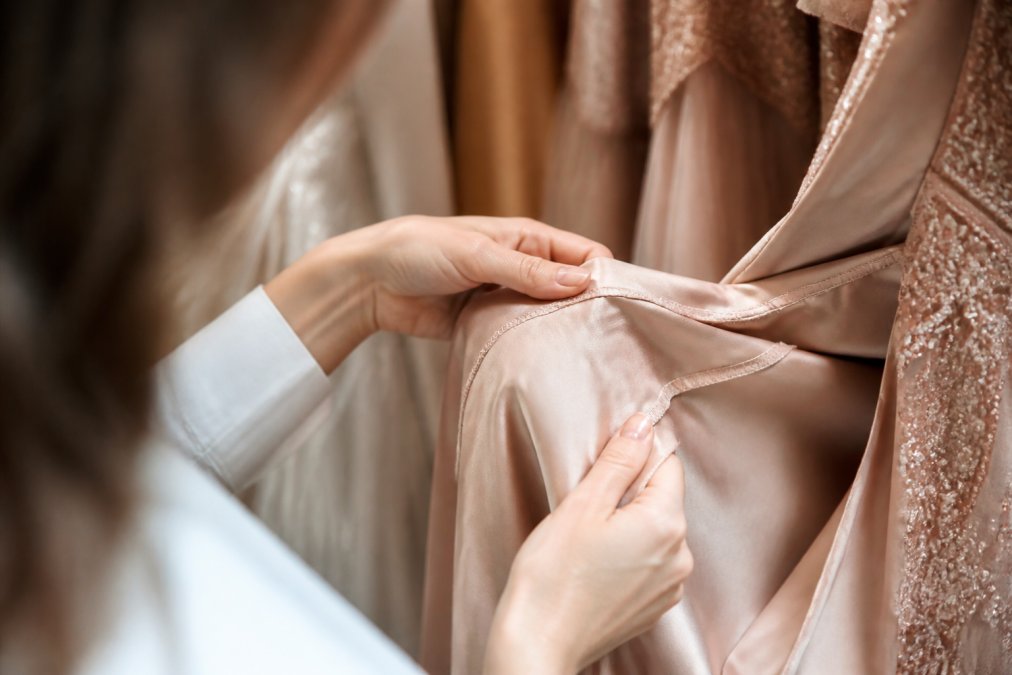
The first thing to check is the inside of the gown, not the outside. Internal structure decides how a dress hangs, how it holds shape, and how long it lasts. A beautiful exterior on a weak foundation will collapse after one evening.
Internal Structure, Lining Quality and Seam Allowance
A fully lined bodice with a smooth inner finish is the baseline for quality evening wear.
Stitching, Hem Finishing and Finishing Details
Check the stitch density in close-up photos. Tight, even, straight lines mean quality control. Wobbly or widely spaced stitches mean speed.
How to Read Clothing Fabric Labels Like a Buyer
A fabric label is a contract. Under the Australian Consumer Law, goods must match their description, and a fibre-content label is part of that description. If the gown arrives and the label contradicts the listing, you have grounds for a remedy.
Natural Fibres vs Synthetic Blends in Evening Gowns
Neither category is automatically better. A heavy-density polyester can outperform a cheap silk. The real question is whether the label tells you the density, the weave, and the finish, and whether the blend makes sense for the gown's structure.
| Blend on Label | Why It Is Used | What It Signals |
|---|---|---|
| 100% silk, crepe de chine | Fluid drape, breathability, natural lustre | Genuine luxury; check for even weave and no slubs |
| Silk + viscose (e.g. 70/30) | Silk gives sheen, viscose cuts cost and adds weight | Mid-tier; acceptable if weave is dense |
| Polyester + spandex (e.g. 95/5) | Stretch for fitted bodices, shape retention | Common in mass production; quality depends entirely on fabric weight (gsm) |
| Acetate + polyester | Acetate mimics silk sheen, polyester adds durability | Often used to fake a silk look; prone to static and shine |
| Triacetate | Resists wrinkling, holds pleats and heat-set shapes | Genuinely good for structured gowns; not a cheap fibre |
| "Mixed fibres" only | Hides the actual composition | Walk away, no reputable atelier lists this |
What Australian Labelling Requires
Fibre content must be accurate and expressed as a percentage. Care instructions must be included. Country of origin must be stated. If a listing claims "silk" but the label says "silk-like" or "silky finish," that is a synthetic blend, and the wording is deliberate. Under the Australian Consumer Law, a product that does not match its description can be returned for a refund or replacement.
Weave Density and Fabric Weight
Composition alone does not tell you quality. Two 100% polyester gowns can differ enormously based on grams per square metre (gsm). A lightweight polyester (under 80 gsm) will feel flimsy and show every seam. A heavy-density polyester (150 gsm and above) can drape like a much more expensive fabric.
Fast-Fashion Indicators: Spotting Mass-Produced Cookie-Cutter Patterns
Cookie-cutter patterns are the clearest giveaway. If the same dress appears under five different brand names at five different prices, you're looking at wholesale apparel sourcing, not design.
Other fast-fashion indicators:
- Trend pieces released weekly, matching whatever is on social media
- Identical product photos across unrelated stores
- No size chart beyond S, M, L
- Prices that make you wonder how anyone was paid to make it
- No information about where or how the gown was produced
Ethical and Sustainable Evening Gown Brands: Supply Chain Transparency
Supply chain transparency means the brand can tell you who made your gown and where the fabric came from. That's it. No vague "ethical production" badges, just names and places.
- Look for a named factory or region on the product page
- Check whether the brand publishes its materials sourcing
- See if they offer repairs or alterations
- Read the returns policy for clues about confidence in fit
Tactile Evaluation Post-Purchase: What to Check When Your Gown Arrives
The gown is in your hands. Now the real inspection starts, and you have a limited window before the returns deadline. Most guides stop at the pre-purchase stage. This is where you separate a genuine investment piece from a fast-fashion gamble, with tests you can run in under a minute each.
The 30-Second Quality Test
Work through this in order. If it fails two or more, return it.
1. The burn test (fibre verification)
- Silk or wool: smells like burnt hair, self-extinguishes, leaves a crushable black ash
- Cotton or viscose: smells like burnt paper, burns steadily, leaves grey ash
- Polyester or acetate: smells chemical/plastic, melts and beads, leaves a hard black bead
2. The seam stress test
3. The lining feel test
4. The opacity check
5. The hardware test
6. The movement test
7. The comparison test
What to Do If It Fails
If the gown fails two or more tests, do not accept it. Goods must be of acceptable quality, match their description, and be fit for purpose (Consumer rights and guarantees). A gown that fails these tests does not meet that standard.
Cost-Per-Wear and Investment Pieces: Deciding What's Worth It
Cost-per-wear is the price of a garment divided by how many times you actually wear it. A gown worn once at $500 costs $500 per wear. The same gown worn ten times costs $50.
Investment pieces share three traits:
- Timeless design that won't date in a season
- Structural integrity that survives cleaning and storage
- Versatile styling across different events and seasons
Frequently Asked Questions
How can I tell if an evening gown is high quality before ordering online?
Look for close-up photos of stitching, lining and seams. Check the fabric composition in the product description; natural fibres or high-quality blends usually signal better construction. Read reviews that mention garment longevity and fit. Brands that show internal structure and finishing details are more likely to deliver atelier-grade craftsmanship rather than mass-produced fast fashion.
What are the key indicators of high-quality garment construction?
Key signs include a full lining that lies flat. Buttons and zips should feel secure and move smoothly. These details separate durable textiles and bespoke tailoring from cookie-cutter patterns.
How do I read clothing fabric labels to judge quality?
Start with the fibre content. Natural fibres like silk, wool or cotton breathe well and age gracefully. Synthetic blends can be durable but may pill or trap heat. Check for care instructions; delicate fabrics often require professional cleaning, which affects cost-per-wear. A label that lists a high percentage of one quality fibre usually indicates better textile integrity than a vague blend.
What should I look for in an online store's return policy to ensure quality?
Look for a straightforward refund process. A generous policy shows the brand stands behind its sizing and quality. Check whether returns are accepted for change of mind and how long refunds take. This protects you if the gown doesn't match the photos or fit as expected.
Buying evening gowns online comes down to one habit: read the construction before you read the price. Check the lining, the seams, the label, and the return policy. At MISTY'S, every piece is built to atelier-grade standards, ships worldwide, and comes with easy returns, so you can inspect the craftsmanship yourself rather than trusting a photo. Browse the collection and find a gown worth wearing more than once.