

Table of Contents
- Petite vs Standard Sizing: What Actually Changes
- Petite vs Standard: Side-by-Side Comparison Table
- How to Measure for Petite Clothing at Home
- Where Standard Patterns Break Down on a Shorter Frame
- Tailoring Standard Clothes for a Petite Frame
- Brand Sizing Variance and International Size Charts
- Petite Styling Tips for Women Over 50
- Frequently Asked Questions
Last Updated: September 14, 2026
Petite vs Standard Sizing: What Actually Changes
Petite vs standard clothing size differences come down to proportion, not overall body size. A petite garment is cut for a shorter frame, with adjusted waist placement, shorter sleeves and a raised crotch depth; a standard garment keeps those points where a taller frame needs them.
Petite is not a size category but a proportion category. You can be a size 8 petite or a size 18 petite, and both need the same construction adjustments.
That distinction changes how you shop. Below, we break down which measurements shift, how to measure yourself at home, and how to tailor standard pieces when petite sizing isn't available. The Australian Competition and Consumer Commission guidance on clothing labelling is a useful starting point for understanding what size labels legally must tell you, which is less than most shoppers assume.
The Height Threshold and Why It Is Not the Whole Story
Most brands draw the petite line under 163cm, many at 160cm (pubmed.ncbi.nlm.nih.gov). That number is a rough filter, not a rule: two women of identical height can need completely different sizing because torso length, leg length and shoulder width vary independently.
A long-torsoed woman at 158cm may find standard tops fit fine and only need shorter sleeves. A short-torsoed woman at 165cm may need petite waist placement despite clearing the height threshold. Height gets you in the door; proportion decides what you buy.
Proportion, Not Overall Size
Proportion describes the relationship between your body's vertical landmarks: shoulder to waist, waist to hip, hip to knee. Petite patterns shorten those vertical distances while keeping horizontal measurements intact.
A petite size 12 and a standard size 12 can have identical bust and hip measurements but sit completely differently: the petite version raises the waistline, shortens the rise and lifts the hemline. Nothing gets narrower; everything gets repositioned.
Petite vs Standard: Side-by-Side Comparison Table
The table below shows where the two constructions typically diverge. Exact figures vary by brand and garment type, so treat them as directional.
| Measurement point | Petite construction | Standard construction | Practical effect |
|---|---|---|---|
| Waist placement | Raised 2-4cm | Set for a longer torso | Waistband sits at the natural waist |
| Sleeve length | Shortened 3-5cm | Cut for longer arms | Cuff lands at the wrist bone |
| Crotch depth | Reduced 2-3cm | Deeper rise | No drooping or bunching |
| Hemline | Raised 5-10cm | Cut for a taller frame | Skirt or trouser breaks correctly |
| Shoulder width | Usually unchanged | Usually unchanged | Same fit across the shoulders |
| Design detail scale | Reduced proportionally | Full scale | Pockets and darts stay balanced |
Shoulder width rarely changes between petite and standard, which is why a petite garment that fits your shoulders but not your waist is a proportion problem, not a size problem.

How to Measure for Petite Clothing at Home
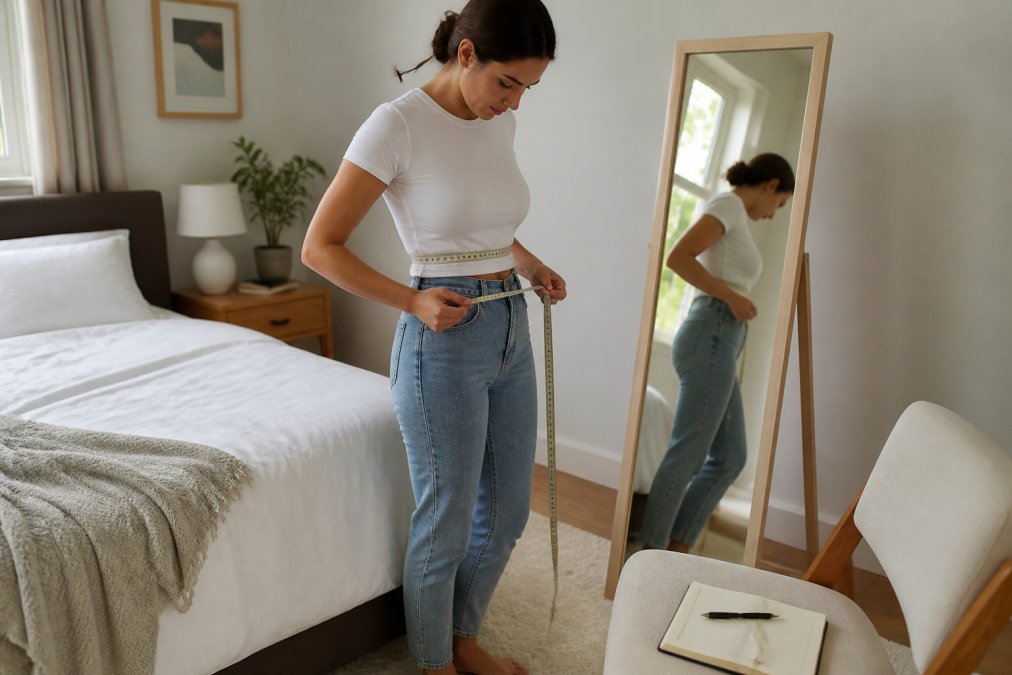
Measuring for petite clothing means capturing four vertical distances, not just your bust, waist and hip circumference: torso length, sleeve length, inseam and crotch depth, because those are the measurements petite patterns actually change.
Grab a soft measuring tape and a notebook. Wear light clothing and stand straight without shoes.
- Torso length: Measure from the top of your shoulder, over the fullest part of your bust, down to your natural waist.
- Sleeve length: Measure from the shoulder seam point to your wrist bone with your arm slightly bent.
- Inseam: Measure from the crotch seam of a well-fitting pair of trousers down to the hem.
- Crotch depth: Sit on a hard chair and measure from your waistband line down to the seat of the chair.
- Natural waist: Find the narrowest point between your ribs and hips, usually just above the navel.
Keep these in your phone. Comparing your torso and inseam figures against a brand's size chart tells you more than any generic height rule. If your torso is short but your inseam is average, you are a mixed case and will likely need petite tops with standard trousers.
Where Standard Patterns Break Down on a Shorter Frame
Standard patterns fail on a shorter frame in predictable places: sleeve length, crotch depth and waist placement, followed by design details that scale badly when a garment is simply cut shorter.
Sleeve Length, Crotch Depth and Waist Placement
Sleeves on a standard garment run long on a shorter frame, so the cuff swallows your hand or bunches at the wrist. Crotch depth is more uncomfortable: a deeper rise than your body needs creates a drooping seat and fabric that gathers at the front.
Waist placement is the one that ruins the silhouette. When a standard waistband sits below your natural waist, it visually lengthens your torso and shortens your legs, the opposite of what most petite shoppers want.
Design Details That Scale Badly
Simply shortening a standard pattern throws design details out of balance: pockets sit too low on the hip, darts land below the bust instead of shaping it. A grade that reduces length without repositioning these elements fits at the seams and looks wrong everywhere else.
Good petite construction adjusts each detail proportionally rather than trimming from the hem, which is why a properly graded petite dress costs more to produce and fits so much better.
Tailoring Standard Clothes for a Petite Frame
Tailoring standard clothes for a petite frame is often cheaper than replacing a wardrobe, but not every garment can be altered. The difference between a straightforward alteration and a structural rebuild comes down to where the excess length sits and how many design details depend on it.
Garments That Alter Easily
These pieces have simple construction and few length-dependent details:
- Straight-leg and wide-leg trousers. Hemming is a simple cut-and-stitch job. If the rise is too deep, a tailor can sometimes raise the waistband, but this is more involved than a hem.
- A-line and bias-cut skirts. The hem can be raised without disturbing the line of the garment, provided the skirt is not heavily panelled or godet-detailed.
- Simple sheath dresses. Taking up the shoulder straps or shortening the hem usually works, as long as the waist seam is not a fixed design feature.
- Long-sleeved tops and shirts with plain cuffs. Sleeves can be shortened from the cuff (cheapest) or from the shoulder, which preserves the cuff detail but costs more.
- Coats and jackets with a simple hem. A straight hem can be raised, but check that the pockets and buttons are not positioned so low that raising the hem crowds them.
Garments That Resist Alteration
These pieces are difficult or impossible to convert from standard to petite without rebuilding:
- Tailored blazers and structured jackets. Waist suppression, pocket placement and button stance are all positioned for a longer torso. Raising the waist means moving the pockets, the buttons and often the entire front panel. Most tailors will decline this job or charge close to the price of a new garment.
- Garments with horizontal design lines. A dress with a waist seam, a peplum, or a contrast band at the hip cannot simply be shortened because the design line will land in the wrong place on a shorter frame.
- Heavily panelled or godet skirts. Shortening these disrupts the flare and the panel proportions, and the result rarely looks intentional.
- Jeans with a complex wash or distressing. Hemming is possible, but the original hem finish is often part of the design. A tailor can reattach the original hem, but this adds cost and is not always invisible.
- Garments with a crotch depth that needs reducing. This is the one alteration worth paying a professional for, and even then it is risky. Reducing crotch depth means opening the seat seam, which affects the fit through the hip and thigh. Getting it wrong shortens the rise too far and the garment becomes unwearable.
A Practical Order of Priority
If you are building a petite-friendly wardrobe from standard pieces, work in this order:
- Hem trousers and skirts first, since this gives the biggest visual improvement for the lowest cost
- Shorten sleeves from the cuff where the design allows
- Take in shoulder straps on dresses rather than altering the bodice
- Raise waistbands only on pieces you wear often enough to justify the cost
- Skip alterations on heavily detailed garments where the darts and pockets would need repositioning
When to Buy Petite Instead
Where tailoring is not practical, buying petite-proportioned pieces outright is the better call. A properly graded petite garment has already repositioned the waist, darts, pockets and hemline, so design details sit where they should on a shorter frame.
MISTY'S stocks pieces cut for shorter frames, including the Summer Fashion Set For Sassy Girls Perfect For Petite Styles, which is graded for petite proportions rather than simply sized down.
Brand Sizing Variance and International Size Charts
Brand sizing variance is the single biggest reason online clothing returns happen, and it has nothing to do with your body. There is no enforceable international standard for women's clothing sizes, so each brand builds its own fit model and grades from there. The Australian Competition and Consumer Commission guidance on clothing labelling sets out what labels must disclose, but it does not mandate that a size 10 means the same thing across brands.
Vanity sizing quietly works against petite shoppers. A brand may label a garment a size 8 when its bust and hip measurements match what another brand calls a size 12. The tag number drifts upward to flatter the wearer, but the pattern does not get shorter in proportion. A petite shopper who normally takes a size 10 may find a vanity-sized size 6 fits horizontally while still being cut for a taller frame vertically, so she orders down and ends up with a garment that is too narrow and still too long.
The fix is to ignore the label number and shop by measurement. Here is a repeatable method for checking any brand's size chart before you order:
- Find the brand's actual body measurements, not the garment measurements. Most size charts list bust, waist and hip circumferences; some also list torso or sleeve length. If a chart only gives circumferences, it cannot tell you whether the garment is cut for a petite or standard frame.
- Compare your recorded torso, sleeve and inseam figures against those numbers. A brand whose size 10 has a 56cm sleeve is cutting for a taller frame than one whose size 10 has a 51cm sleeve, even if the bust and hip figures are identical.
- Check the petite range separately. If the petite chart shows the same bust and hip measurements but shorter sleeve, torso and inseam figures, that is a true proportion adjustment. If it simply shows smaller circumferences across the board, the brand is using 'petite' as a synonym for 'small'.
- Look for a 'runs small' or 'runs large' note. Many imported garments run one to two sizes smaller than European and American equivalents. That note reflects a genuinely different base pattern, often graded from an Asian fit model with a shorter torso and narrower shoulder.
- Size up when you fall between two sizes, then tailor down. It is far easier to take in a waistband or shorten a hem than to let out a seam that has no allowance.
International size charts make this worse because the same number means different things in different markets. A size 38 in European labelling may correspond to a size 10 in one system and a size 12 in another. When a product page lists multiple conversions, start with the one that matches your body measurements, not the number you usually buy.
MISTY'S provides detailed product information to help you make informed choices. Before ordering, comparing your measurements against the specific product's details can help remove some of the guesswork from buying clothing online.
Petite Styling Tips for Women Over 50
Petite styling tips for women over 50 start with the same principle as any age: proportion first, trends second. Keep vertical lines unbroken and place visual weight where it flatters your frame.
- Choose monochrome or low-contrast outfits to create one continuous vertical line
- Keep hemlines at or above the knee, or go full length, and avoid the mid-calf chop that shortens legs
- Use a defined waist, whether by cut or a belt, to mark where your natural waist sits
- Pick V-necks and open collars over high, closed necklines
- Avoid oversized prints that overwhelm a shorter frame
- Choose structured fabrics that hold their shape rather than clinging
For evening wear, a well-cut gown in a single colour does more for a petite frame than any amount of pattern mixing. The Mermaid Bridesmaid Dress Off-shoulder Plus-size Elegant Wedding Guest Gown uses three-dimensional cutting to shape the silhouette, which matters more on a shorter frame than fabric volume.

Petite sizing gets treated as a niche when it is really just good pattern grading applied to a shorter frame. Most brands either skip it or apply it badly, leaving you guessing between labels that mean different things. MISTY'S offers atelier-grade construction, worldwide shipping, and an easy returns process. Continue shopping and explore our collection designed to make every woman feel confident and sophisticated.
Frequently Asked Questions
How much smaller is petite than regular sizing?
Petite sizing is not simply a smaller version of standard sizing. The main adjustments are in length and placement: sleeves are generally 2 to 5 centimetres shorter, hemlines sit higher, and the waistline is positioned closer to the ribcage. Overall body width may be similar to a standard size, which is why a petite 10 is not the same as a standard 8. The changes target proportion rather than reducing the whole garment.
Should you size up when buying petite clothes?
No, sizing up defeats the purpose of petite sizing. Petite garments are cut for a shorter frame with adjusted waist placement, crotch depth and sleeve length, not for a smaller body. Sizing up adds width you do not need and moves the waistline lower. Instead, check the brand's size chart and measure your bust, waist, hip, inseam and torso length before ordering. If you fall between two sizes, choose based on your largest measurement.
Should I buy petite if I am 160 cm tall?
At 160 cm, petite sizing is usually the better starting point, but height alone is not the deciding factor. What matters more is your torso length, inseam and where your natural waist sits. A 160 cm woman with a long torso and short legs may fit petite bottoms better than petite tops. Measure your inseam and torso length, compare them against the brand's size chart, and treat the height threshold as a guide rather than a rule.
Is petite sizing only about height, or does it affect garment proportions?
Proportion is the whole point of petite sizing. A standard pattern is graded from a fit model of average height, so when it is scaled down, the darts, waistline, shoulder width and hemline all shift. Petite patterns reposition the waist higher, shorten the crotch depth, raise the hemline and adjust dart placement. Two women of the same height can need different petite adjustments depending on whether their length sits in the torso or the legs.
Can someone of average height benefit from petite sizing?
Yes, if your proportions run short rather than your overall height. A woman of average height with a short torso and long legs may find petite tops sit better because the waistline lands in the right place. The reverse also applies: a shorter woman with a long torso may prefer standard tops with petite bottoms. Judge by where the garment's waist, shoulder seam and hemline land on your body, not by the label on the tag.